Introduction
Whether you're clearing overgrown pastures, maintaining roadside vegetation, or managing orchard floors, the blades on your flail mower determine cut quality, equipment wear, and operating cost more than any other component. Yet Y-blades and hammer blades are frequently confused or interchanged without understanding the consequences.
Both blade types are standard on flail mowers, but they serve fundamentally different purposes. Using the wrong type on the wrong terrain leads to premature blade failure, poor cut finish, increased fuel draw, and added stress on the PTO and rotor.
A Y-blade deployed in rocky brush destroys blades and risks machine damage. Running hammer blades over a manicured orchard wastes fuel and leaves a rough finish.
The breakdown below covers shape, cutting action, ideal applications, and durability — so you can match the right blade to the job before it costs you.
Key Takeaways
- Y-blades are lightweight, knife-like blades that slice cleanly through grass and soft vegetation—ideal for lawns, orchards, and manicured areas
- Hammer blades are heavier and blunt-edged, using momentum to pulverize woody material and thick brush—better suited to rough terrain and land clearing than finish work
- The right blade changes your PTO load, cut quality, and how long the blade holds up in debris-heavy conditions
- Neither blade is universally better—the right choice depends on vegetation type, terrain, and whether you prioritize finish or clearing power
- Blade coating and steel hardness affect longevity regardless of blade style
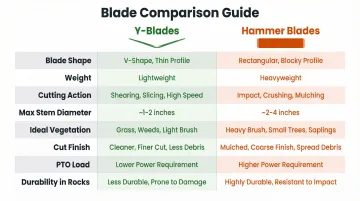
Y-Blades vs. Hammer Blades: Quick Comparison
| Feature | Y-Blades | Hammer Blades |
|---|---|---|
| Blade Shape | Thin, Y-shaped or V-shaped profile | Thick, rectangular or wedge-shaped |
| Weight | Lightweight (as low as 3 ounces) | Heavy (10–15× heavier, up to 1,590 grams) |
| Cutting Action | High-speed slicing with sharp edges | Blunt-force impact and pulverizing |
| Max Stem Diameter | 0.75"–1.5" | 2.0"–3.5"+ |
| Ideal Vegetation | Grass, light weeds, soft cover crops | Thick brush, woody stems, saplings |
| Cut Finish | Clean, uniform, manicured appearance | Coarse, chunky mulch |
| PTO Load & Fuel | Lower demand, more fuel-efficient | Higher demand, increased fuel consumption |
| Durability in Rocks | Moderate—prone to bending/chipping | Excellent—absorbs impacts without damage |
| Cost per Blade | Generally lower unit cost | Higher unit cost due to weight and material |
Both blade types mount on the same rotor shackle or bracket system on most flail mowers, but they are not interchangeable from a performance standpoint. Swapping blade types affects PTO load, vibration profile, and cut quality — not just what ends up on the ground.
Before switching, keep these points in mind:
- Some mowers ship with one blade type as standard but accept aftermarket alternatives — confirm compatibility first
- Always verify rotor balance requirements; hammer blades run 10–15× heavier than Y-blades
- Replace in matched sets — mixing blade weights creates vibration that can destroy rotor bearings and gearboxes
What Are Y-Blades?
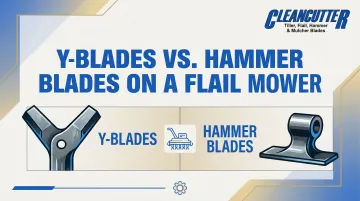
Y-blades—also called knife blades or slat blades—are named for their Y-shaped profile. These thin, flat cutting tools are typically manufactured from medium-carbon or high-carbon steel. Their geometry creates two or three cutting edges that slice through vegetation rather than hammer it into submission.
Cutting Action
Y-blades rely on blade-tip velocity and a sharp cutting edge to shear plant stems cleanly. Documented blade-tip speeds across OEM configurations range from 8,622 fpm (John Deere FL1053) to 9,805 fpm (Land Pride FM3188), according to manufacturer spec sheets. This slicing action produces a finer, more uniform mulch and a noticeably cleaner ground-level finish compared to hammer blades.
Operational Advantages
Lighter weight means lower rotational mass, which reduces strain on the PTO shaft, gearbox, and rotor bearings. This translates to lower fuel consumption per acre and reduced heat buildup during extended mowing sessions — a meaningful advantage on high-frequency mowing routes, as independent testing confirms.
Limitations
Y-blades are vulnerable in rocky or debris-laden terrain. A hard strike against a stone or buried object can bend or chip the blade. Because they are thinner, they wear faster when used on coarse or abrasive vegetation. OEM specifications rate Y-blades for maximum stem diameters of 0.75" to 1.5"—they are not recommended for woody stems above this range.
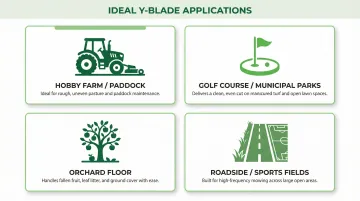
Use Cases of Y-Blades
Y-blades are the right choice when finish quality and fuel efficiency matter more than brute force:
- Hobby farmers and landscapers maintaining paddocks or turf
- Golf course groundskeepers and municipal parks crews on established grass
- Orchard operators needing precise ground-level cutting
- Roadside and sports field crews working predominantly soft vegetation
For operators running Y-blades on higher-frequency mowing cycles, blade coating technology can extend service life considerably. Clean Cutter's Super-Koat and hard-faced blade options let you improve Y-blade longevity without switching blade types entirely.
What Are Hammer Blades?
Hammer blades—also called flail hammers or hammer knives—are thick, heavy, rectangular or wedge-shaped blades mounted on the same shackle system as Y-blades. While a standard Y-blade may weigh approximately 3 ounces, documented hammer blade weights include 1,110 grams (Maschio) and 1,590 grams (Berti)—easily 10–15× heavier. Their design prioritizes mass and impact resistance over cutting-edge sharpness.
Cutting Action
Hammer blades work by high-speed impact rather than slicing. The blade's momentum shatters and pulverizes woody stems, thick weeds, and debris on contact. This produces a coarser, chunkier mulch that decomposes more slowly but covers larger material.
Durability Advantage
Greater blade mass means hammer blades absorb rock strikes and debris impacts without bending or chipping as readily as Y-blades. They are specifically designed for environments where hidden rocks, stumps, or buried debris are constant risks.
Hammer blades are mounted on pivots (clevises or D-rings) that allow them to swing freely and fold back upon striking immovable objects, preventing destructive forces from transferring to the gearbox or tractor drivetrain.
Trade-Offs
The added rotor weight increases PTO load and fuel consumption. The impact-based cutting action leaves a rougher finish. Hammer blades generate more vibration and noise during operation, which increases wear on rotor bearings, shackle pins, and the gearbox over time. Operators in rocky fields should inspect shackle hardware more frequently.
Those trade-offs are manageable in the right conditions—and for the applications below, hammer blades are often the only practical choice.
Use Cases of Hammer Blades
Hammer blades are the go-to choice for:
- Overgrown fields with mixed woody and grassy vegetation
- Roadsides and ditch banks with embedded gravel or debris
- Reclaimed land clearing and pasture renovation with brambles or thick-stemmed weeds
- Any application involving small branches or brush up to 2–3 inches in diameter
Typical operators include cattle ranchers, highway maintenance crews, land clearing contractors, municipal roadside mowing operations, and property owners reclaiming acreage where finish quality is secondary to throughput.
In heavy-duty applications, blade wear is a primary operating cost. Hard-faced hammer blades can cut replacement intervals considerably. According to field data from ATC Group, hardfaced flail blades achieve 3 to 4 times greater wear life compared to standard non-hardfaced boron blades. That's where Clean Cutter's hardness grades—Plain, Hard-Faced, and Super-Koated—become a direct cost decision for hammer blade buyers.
Y-Blades vs. Hammer Blades: Which Should You Choose?
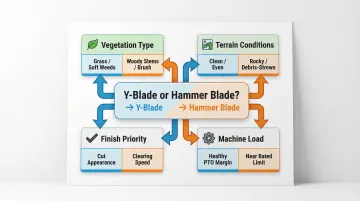
The decision comes down to four key factors:
- Vegetation type — grass and soft weeds, or woody stems and brush?
- Terrain conditions — clean and even ground, or rocky and debris-strewn?
- Finish priority — cut appearance, or clearing speed?
- Machine load — healthy PTO HP margin, or close to the implement's rated limit?
Situational Guidance
Choose Y-blades if:
- Your primary task is grass and light vegetation maintenance
- Finish quality matters
- Terrain is relatively clear
- You want lower fuel draw and less drivetrain stress
- Vegetation stems are consistently under 1.5 inches in diameter
Choose hammer blades if:
- You're clearing thick brush or woody material
- Mowing rocky or debris-heavy land
- Managing vegetation over 1.5 inches in stem diameter
- Durability matters more than cut aesthetics
- You need to pulverize material into fine mulch quickly
Mixed-Use Scenarios
For operators managing both grass maintenance and occasional brush clearing on the same property, there's a practical trade-off: maintain two blade sets or accept a compromise blade type (sometimes called universal blades). Note that switching blade types requires replacing all blades simultaneously to maintain rotor balance. Factor that into your blade swap schedule.
One option sometimes floated for mixed use is scoop blades—but they're purpose-built for a different job. Scoop blades are highly specialized for turf renovation, scarifying, and dethatching where soil engagement is required—not a true middle-ground for brush and grass.
Conclusion
The right blade comes down to what you're cutting and where. Y-blades suit clean, open grass; hammer blades handle woody stems, rough terrain, and debris-heavy conditions. Match the blade to the job — that's the whole decision.
Whichever type you run, blade hardness grade and coating quality are the factors most operators overlook when calculating total operating cost. The right hardness grade for your conditions — whether Y-blade or hammer — directly affects how often you're pulling blades and ordering replacements. Operators who get this right spend less on downtime across a full season.
A quick reference for matching coating to conditions:
- Plain — light-duty mowing, low abrasion, lowest upfront cost
- Hard-Faced — mixed terrain, moderate rock and debris exposure
- Super-Koated — high-wear conditions, extended service life, abrasive soils
Clean Cutter's cross-reference system helps operators find compatible Y-blade and hammer blade options for their specific flail mower model, with Plain, Hard-Faced, and Super-Koated options available across the catalog.
Frequently Asked Questions
What is the difference between hammer blades and Y blades on a flail mower?
Y-blades are lightweight, knife-shaped blades designed to slice through grass and soft vegetation cleanly, while hammer blades are heavy, impact-based blades designed to pulverize woody stems and debris. The key difference is cutting action (slicing vs. impact) and the vegetation type each handles best.
What types of blades are best for a flail mower?
The best blade type depends on the application: Y-blades suit clean grass cutting and finish mowing, while hammer blades handle heavy brush and rough terrain. Steel hardness grade is also worth considering, since harder coatings extend blade life significantly in abrasive conditions.
Which flail mower blades give the best cut?
Y-blades produce the cleanest, most uniform cut finish on grass and light vegetation due to their slicing action, while hammer blades produce a coarser mulch. For aesthetic or precision applications, Y-blades are the better choice.
How long do flail mower blades last?
Blade lifespan depends on terrain, vegetation type, and steel hardness. Plain steel blades in rocky conditions may last only one season, while hard-faced or coated blades last significantly longer in the same conditions. Replace blades as a set, not individually, and inspect regularly.
Do you sharpen flail mower blades?
Y-blades can be sharpened because their cutting action depends on a sharp edge, though sharpening should be done carefully to maintain blade balance. Hammer blades rely on mass and impact rather than edge sharpness, so they are not sharpened. Heavily worn hammer blades are replaced rather than reconditioned.
Can a flail mower cut brambles?
Flail mowers can cut brambles effectively, and hammer blades are the recommended choice for bramble clearing due to their impact strength and resistance to tough, wiry stems. Y-blades can handle light bramble but will wear and bend faster under heavy bramble loads.