Introduction
Flail mower operators face a recurring dilemma every season: OEM blades deliver reliable performance but command premium prices, while aftermarket options promise significant savings. The wrong choice doesn't just affect your budget—it hits cut quality, blade lifespan, machine safety, and total operating cost. For operators replacing blades multiple times per season across large fleets or demanding terrain, one bad decision can cascade into thousands of dollars in downtime, fuel waste, and equipment damage.
Worn or mismatched blades create rotor imbalance at speeds exceeding 2,000 RPM, destroying bearings and drive housings. Dull blades tear vegetation instead of cutting cleanly, spiking fuel consumption and stressing your PTO system. This guide breaks down what separates quality aftermarket blades from substandard ones, what OEM specs actually guarantee, and how to make the right call for your operation.
Key Takeaways
- OEM blades meet exact factory specifications for guaranteed fit, but cost significantly more per unit
- Quality aftermarket blades from established manufacturers can match or exceed OEM performance when engineered with superior steel grades or advanced coatings
- The aftermarket category spans from cheap import blades to precision-engineered replacements—mixing them up is a costly mistake
- For high-frequency operations, quality aftermarket blades typically deliver better cost-per-hour value
- The right choice depends on warranty status, replacement frequency, terrain conditions, and supplier quality
OEM vs Aftermarket Flail Mower Blades: Quick Comparison
Cost
| OEM | Aftermarket | |
|---|---|---|
| Price range (per blade) | $3.11–$93.85 | $2.79–$14.50 |
| Specialized designs (e.g., duckfoot knives) | ~$22.91/blade | Varies by supplier |
| Full set (72–120 blades) | Higher total cost | Hundreds saved per cycle |
| Fleet volume pricing | Limited | Significant savings |
RhinoAg's published OEM pricing reflects the brand premium built into every blade. For operators replacing full sets multiple times per season, those premiums compound fast.
Steel Composition and Hardness Options
OEM Approach: OEMs typically offer one standard steel grade per blade model with limited hardness options. While they use terms like "heat-treated" or "drop-forged," specific Brinell or Rockwell hardness ratings are rarely published in public spec sheets.
Aftermarket Advantage: Quality aftermarket manufacturers offer multiple grades:
- Plain steel — adequate for light-duty mowing on clean ground
- Hard-faced — overlay welding builds up wear-resistant layers, better suited for rocky or abrasive terrain
- Coated options (such as Clean Cutter's Super-Koat) — advanced surface treatments that extend service life in high-wear conditions
Aftermarket suppliers often use boron-alloy steels like 30MnB5, achieving hardness ratings between 40 and 55 HRC after heat treatment—meeting or exceeding ISO 5718 agricultural blade standards.
Availability and Compatibility
OEM Limitations: OEM parts tie you to dealer stock and manufacturer supply chains. Older models face delays or discontinuation as manufacturers phase out parts. Lead times can stretch during peak season when you need blades immediately.
Aftermarket Flexibility: Established aftermarket suppliers maintain cross-reference systems matching blades to dozens of OEM models across brands like Alamo-Mott, Rhino, Maschio, Loftness, and Seppi. Broader distribution networks mean faster availability when downtime costs money.
What Are OEM Flail Mower Blades?
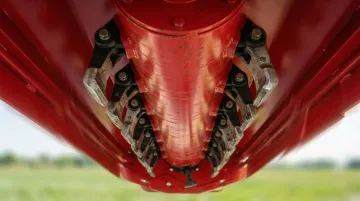
OEM flail mower blades are manufactured or contracted by the original equipment brand—companies like Alamo, Rhino, Loftness—and sold as official replacement parts. They're designed and tested to fit specific machine drum geometry and bolt patterns with factory-verified dimensional tolerances.
The primary benefit is guaranteed dimensional fit. Rhino notes their flail rotors turn at speeds exceeding 2,000 RPM and are dynamically balanced at the factory—differences in blade weight from wear or mixing non-genuine parts can cause severe vibration and damage. OEM blades eliminate compatibility guesswork, which matters most for operators with newer equipment still under manufacturer warranty.
That said, OEM blades come with real trade-offs:
- Carry a brand markup that adds up fast as a seasonal consumable
- Typically come in one standard steel grade, with no harder alternatives available
- Can face supply delays or discontinuation for older machine models
Alamo Industrial's warranty explicitly states that only genuine replacement parts are approved for warranty repairs, creating pressure to stay within their ecosystem despite higher costs. That warranty lock-in is worth understanding before deciding when OEM is the right call.
Use Cases for OEM Blades
OEM blades make the most sense in these situations:
- Equipment still under manufacturer warranty, where non-genuine parts void coverage
- Occasional-use machines where the cost premium per blade is negligible
- Dealer-managed rental fleets where parts procurement runs through the brand
- Mowers with unusually tight dimensional tolerances that limit aftermarket options
What Are Aftermarket Flail Mower Blades?
Aftermarket flail mower blades are manufactured by third-party companies—not the original equipment brand—designed to be dimensionally compatible with OEM mower drums. The term "aftermarket" covers a wide range of quality, from low-cost imports to precision-engineered replacements. Where a supplier falls on that range determines whether you're getting value or a liability.
Quality Varies Significantly:
The key differentiators separating premium aftermarket from cheap imports are:
- Steel quality - Brinell hardness rating and alloy composition
- Manufacturing tolerances - Precision in dimensions and weight consistency
- Heat treatment processes - Proper quenching and tempering procedures
- Surface hardening technology - Advanced coatings or overlay welding
Steel Grade Options:
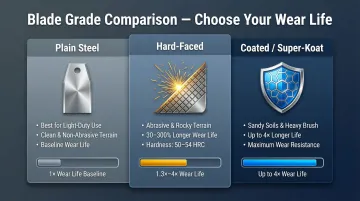
Quality aftermarket manufacturers offer three distinct grades:
| Grade | Best For | Wear Life |
|---|---|---|
| Plain (Standard Steel) | Light-duty, clean terrain, low-abrasion conditions | Baseline |
| Hard-Faced | Abrasive soils, moderate impact; chromium or tungsten carbide overlay reaches 50–54 HRC | 30%–300% longer than non-surfaced parts |
| Coated | Sandy soils, roadside debris, heavy brush; robotically applied tungsten carbide overlay | Up to 4× longer than non-coated alternatives |
Manufacturer Experience Matters:
Clean Cutter has manufactured flail and tiller blades since 1963, developing proprietary technologies that push wear life beyond standard OEM steel grades. Their Super-Koat coating is one example of what separates an engineered solution from a commodity import.
Their catalog covers compatibility with major OEM brands including Alamo-Mott, Rhino, Maschio, Loftness, Seppi, and Sicma.
Cross-Reference Compatibility System:
Reputable aftermarket suppliers maintain part cross-reference catalogs so operators can identify correct replacements by OEM part number or machine model. Input your OEM part number and get the dimensionally equivalent aftermarket blade with full specs: length, width, thickness, and mounting hole pattern.
Use Cases for Aftermarket Blades
Aftermarket blades are the practical choice in several situations:
- High-volume fleets — Large farms, roadside contractors, and landscaping operations where per-blade cost compounds across hundreds of replacements per season
- Abrasive terrain — Rocky ground, sandy soils, or heavy brush where hard-faced or coated grades outlast standard OEM steel
- Older equipment — Machines where OEM parts are delayed or discontinued; aftermarket suppliers typically stock aging models long after OEMs stop
- Performance testing — Operators dialing in the right hardness grade for their specific soil and cut conditions
OEM vs Aftermarket: Which Should You Choose?
The right choice depends on four variables: machine age and warranty status, replacement frequency, terrain conditions, and aftermarket source quality. None of those factors point automatically to OEM or aftermarket — the decision is situational.
Choose OEM If:
Your machine is under warranty and the manufacturer requires OEM parts for coverage. While the Magnuson-Moss Warranty Act prohibits OEMs from voiding warranties simply because you used aftermarket parts, avoiding potential disputes during the warranty period may be worth the premium.
You replace blades infrequently and the cost premium is negligible compared to your total operating budget. For occasional-use equipment, the guaranteed fit outweighs modest savings.
You're running highly specialized mowers where dimensional tolerances are extremely tight and rotor balance is critical. Some high-speed professional mowers have zero tolerance for weight variance.
Choose Quality Aftermarket If:
You replace blades frequently and cost-per-season matters. When you're changing blade sets every 50 to 100 hours across multiple machines, aftermarket pricing changes your economics substantially.
Your terrain demands harder grades. Rocky, sandy, or debris-laden conditions wear standard OEM blades quickly. Hard-faced and coated aftermarket options exist specifically for these conditions — they deliver measurably longer wear life where standard steel falls short.
You operate older machines where OEM parts are hard to source or face long lead times. Aftermarket suppliers often maintain broader inventory for legacy equipment.
You want performance optimization. Testing different hardness levels helps you find the optimal blade for your specific cutting conditions and replacement interval goals.
Address the Quality Concern Head-On
Cheap, unknown-brand aftermarket blades often use inferior steel grades and lack dimensional consistency, creating false economy and safety risk. The risk isn't aftermarket as a category — it's sourcing from suppliers who can't document what they're selling.
Vet aftermarket suppliers by verifying:
- Documented steel grades and hardness ratings
- Decades of manufacturing experience
- Published cross-reference catalogs
- Known compatibility with your specific OEM brand
Suppliers like Clean Cutter — manufacturing since 1963 — publish full cross-reference catalogs, document hardness grades across Plain, Hard-Faced, and Super-Koat options, and carry verified compatibility for major OEM brands including Alamo-Mott, Rhino, and Loftness. That's the standard worth holding any aftermarket source to.
Total Cost of Ownership Perspective
Industry guidance suggests flail blades last between 50 to 200 hours depending on terrain and material being cut. For high-frequency replacement use cases, a blade that lasts 20-30% longer at the same or lower price changes the economics significantly.
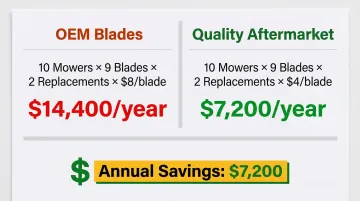
Consider this scenario: A roadside maintenance fleet running 10 mowers, each requiring 90 blades per set, replacing blades twice per season:
- OEM cost: 10 mowers × 90 blades × 2 replacements × $8/blade = $14,400/year
- Quality aftermarket: 10 mowers × 90 blades × 2 replacements × $4/blade = $7,200/year
- Annual savings: $7,200
If superior coating extends blade life by 20%, that fleet could skip a full replacement cycle every few seasons — adding another $1,440+ in avoided costs on top of the per-blade savings.
Conclusion
There's no universal winner in the OEM vs aftermarket debate—both have legitimate use cases. OEM blades offer guaranteed fit and manufacturer alignment, making them the right choice for warranty-sensitive situations, low-replacement operations, or compliance-driven procurement. Quality aftermarket blades offer flexibility in steel grade, broader availability, and often better economics at scale—provided they come from a proven manufacturer.
For most working flail mower operators replacing blades regularly across demanding terrain, a quality aftermarket blade from a manufacturer with decades of engineering experience will outperform a standard OEM blade on cost-per-hour value. Clean Cutter, for example, has been manufacturing flail blades since 1963, with proprietary options like Super-Koat coating and hard-faced steel that extend blade life in demanding conditions where stock OEM blades fall short.
The key is knowing where your source stands. Don't confuse cheap import blades with precision-engineered aftermarket replacements. Before buying, confirm:
- Steel grade and hardness specifications
- Cross-reference compatibility with your specific OEM equipment
- Supplier documentation and track record
The right blade for your operation exists. Finding it takes about five minutes of due diligence—and it's worth every one of them.
Frequently Asked Questions
Do new mower blades make a difference?
Yes, significantly. New blades—OEM or quality aftermarket—improve cut quality and reduce fuel consumption compared to worn ones. Dull blades force the mower to work harder, accelerating overheating and mechanical fatigue. In most field situations, blade condition matters more than brand.
Will aftermarket flail mower blades void my mower's warranty?
In most cases, no. The Magnuson-Moss Warranty Act prohibits OEMs from voiding warranties simply because you used aftermarket blades. A claim can only be denied if the OEM proves the aftermarket part directly caused the defect—so review your warranty terms, but federal law generally protects you.
How do I know if an aftermarket flail blade is compatible with my mower?
Reputable suppliers maintain cross-reference catalogs matched to OEM part numbers—verify that mounting hole dimensions, blade length, width, and thickness align with your drum's spec. Clean Cutter provides detailed compatibility information for brands including Alamo-Mott, Rhino, Maschio, and Loftness.
How often should flail mower blades be replaced?
Blades typically last 50–200 hours depending on terrain—rocky or abrasive soils cut that range short. Inspect every 8–10 hours for chips, cracks, or warping, and replace once the leading edge has worn back more than 1/4 inch or cut quality drops noticeably.
What is the difference between hard-faced and plain aftermarket flail blades?
Plain blades use standard steel with uniform hardness throughout, suitable for light-duty applications. Hard-faced blades have a wear-resistant overlay—typically chromium carbide or tungsten carbide—applied to the cutting surface through welding. This makes them better suited for rocky, abrasive, or high-intensity applications where blade wear is the primary concern, often extending life by 30-300% compared to plain blades.
Are cheap aftermarket flail mower blades worth it?
No. Cheap, unknown-brand blades often use inferior steel, lack dimensional consistency, and fail early—wasted spend and a real safety hazard. Rotor imbalance from inconsistent blade weight causes severe vibration that destroys bearings and housings. The value in aftermarket comes from choosing established manufacturers with documented specs and known compatibility—not the lowest price.