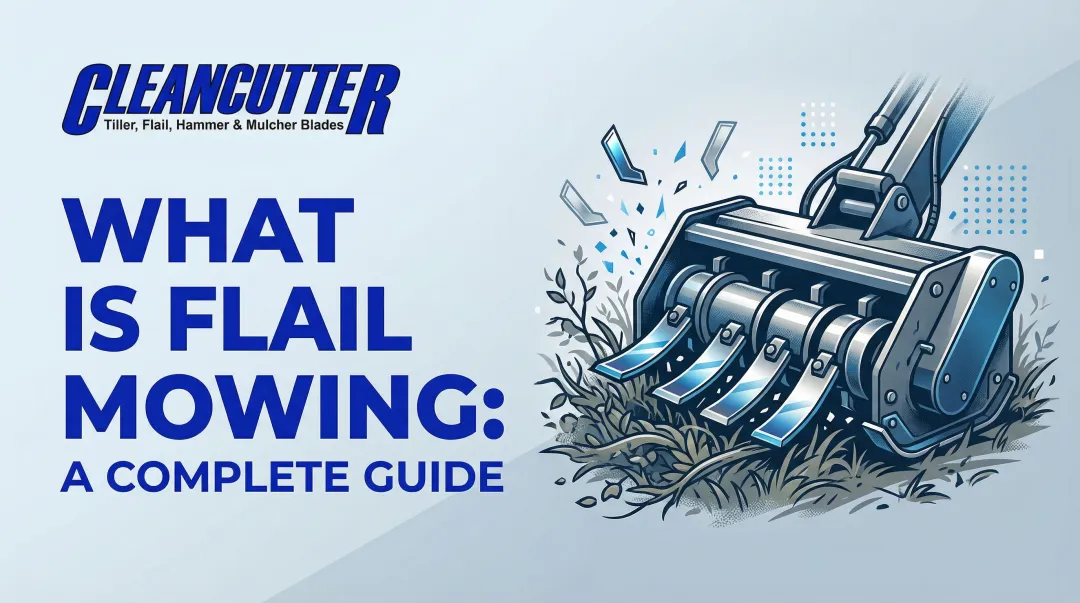

A flail mower is a PTO-driven implement that uses multiple small blades (called flails) mounted on a rotating horizontal drum to cut, mulch, and manage heavy vegetation that rotary mowers and brush hogs can't handle cleanly. Unlike rotary cutters with large spinning blades, flail mowers use dozens of hinged blades that fold back when they hit rocks or stumps—reducing projectile risk and delivering a finer, more consistent cut. This guide covers the top flail mower brands compatible with tractors in the 25–100 HP range, explains how blade type affects longevity and cut quality, and walks through the specs you need to match a mower to your machine.
Key Takeaways
- Flail mowers use spinning blades on a horizontal drum to cut and mulch dense vegetation, producing safer, finer results than rotary mowers
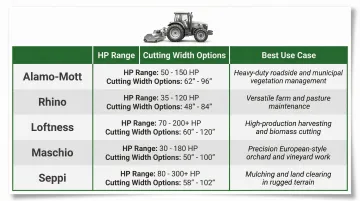
- Top brands include Alamo-Mott, Rhino, Loftness, Maschio, and Seppi—each suited to different HP ranges and applications
- Blade type matters: Y-blades handle general cutting, hammer blades tackle woody brush, and finish blades produce clean turf cuts
- Match cutting width to PTO horsepower—compact tractors (25–40 HP) suit 48"–60" decks; larger tractors (50–100 HP) handle 72"–96" units
- Quality replacement blades make a real difference in uptime—Clean Cutter's hard-faced and Super-Koat options are engineered to outlast standard OEM flails
Top Flail Mower Brands for Tractors
These brands were selected based on build quality, HP compatibility range, parts availability, and suitability for U.S. agricultural and landscaping applications.
Alamo-Mott
Alamo Industrial, headquartered in Seguin, Texas, has supplied highway departments, municipalities, and farms with heavy-duty flail mowers for decades. Their tractor-mounted units are built for continuous-use applications where equipment runs hundreds of hours per season.
Robust rotor housing, wide cutting widths (up to 98"), and strong aftermarket parts support across North America reduce per-season parts and downtime costs for high-use operations. The Super Heavy Duty (SHD) rear-mount series appears in state procurement documents, including New York State DOT specifications for roadside vegetation management.
| Spec | Detail |
|---|---|
| Best Use Case | Roadside maintenance, pasture management, heavy grass and weed control |
| HP Range | 45–100 HP tractors |
| Cutting Width Options | 60" to 98" |
Rhino
Rhino (originally Texas-based, now headquartered in Gibson City, Illinois) produces a broad lineup of flail mowers for agricultural and land management use, with specific sizing for 25–50 HP tractors that suits smaller farm operations and rural landowners.
Their durable gearbox design and wide U.S. dealer network — split into "Premiere" and "Stocking" tiers — make parts and service accessible across most regions. The RSM series covers mowing widths from 61" to 86". Standard models require 25 PTO HP; heavy-duty RSM-H models (with 2" capacity brush hammers) step up to 35 PTO HP.
| Spec | Detail |
|---|---|
| Best Use Case | Farm pasture, rough terrain mowing, fence line clearing |
| HP Range | 25–75 HP tractors |
| Cutting Width Options | 48" to 84" |
Loftness
Minnesota-based Loftness builds high-performance flail mowers for heavy vegetation, woody brush, and light forestry work on utility-class tractors. Their PTO-driven models are built for right-of-way clearing where material needs to be mulched down, not just cut off.
Reinforced rotor housings and U.S.-based parts distribution make servicing straightforward. Two common models: the 72M (72" width, 25–70 PTO HP) and the 90M (90" width, 30–70 PTO HP).
| Spec | Detail |
|---|---|
| Best Use Case | Brush clearing, light forestry, land reclamation |
| HP Range | 50–120 HP tractors |
| Cutting Width Options | 60" to 96" |
Maschio
Maschio is an Italian-designed brand widely distributed across North America, with rear-mounted PTO models known for consistent cut quality across varied terrain. The BRAVA series targets intensive mulching in orchards, vineyards, and managed green spaces.
Fine mulching performance, tight blade tolerances that reduce material clumping, and factory availability of both Y-blade and hammer blade configurations give Maschio flexibility across turf and rough-cut applications.
| Spec | Detail |
|---|---|
| Best Use Case | Vineyard maintenance, orchard use, finish-quality mulching |
| HP Range | 30–80 HP tractors |
| Cutting Width Options | 55" to 88" |
Seppi
Founded in 1939 and now based in West Chester, Ohio for U.S. operations, Seppi builds heavy-duty mulching flail mowers used in professional vegetation management, forestry preparation, and large-scale land clearing.
Hardened steel rotor systems with precision-balanced blade carriers keep vibration low and extend service intervals in demanding conditions. High blade density configurations improve mulching efficiency per pass — the MIDIFORST series handles wood up to 10 inches in diameter.
| Spec | Detail |
|---|---|
| Best Use Case | Heavy shrub mulching, forestry, professional land clearing |
| HP Range | 60–150 HP tractors |
| Cutting Width Options | 60" to 118" |
Flail Mower Blade Types: Matching the Cut to the Job
The blade type (also called the flail type or knife type) is one of the most consequential decisions after choosing a mower brand. It determines cut quality, debris management, and how quickly blades wear out depending on the material being cut.
Y-Blades (Standard Flails)
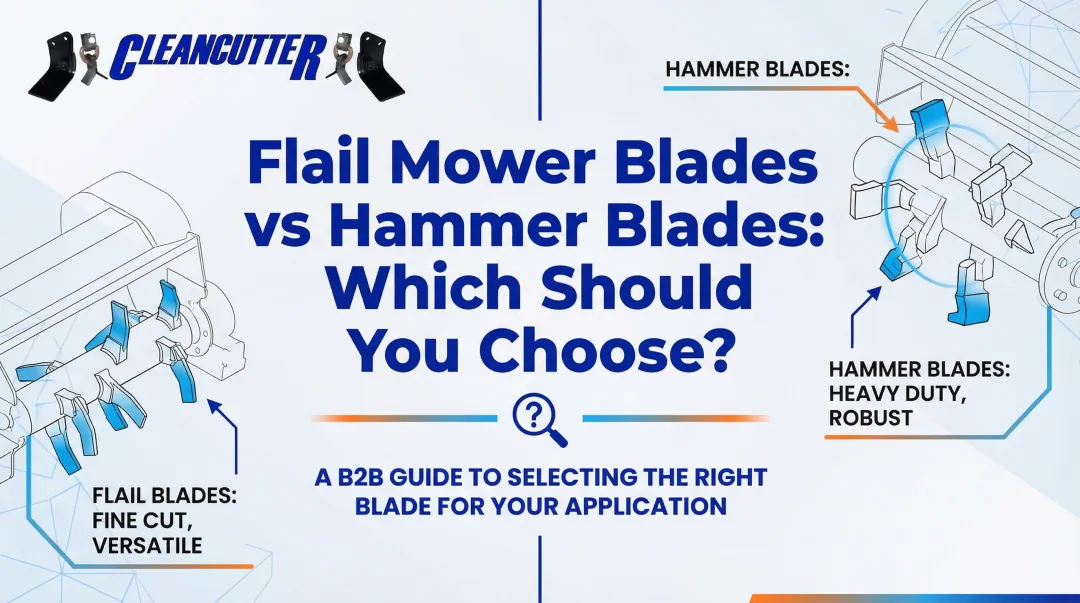
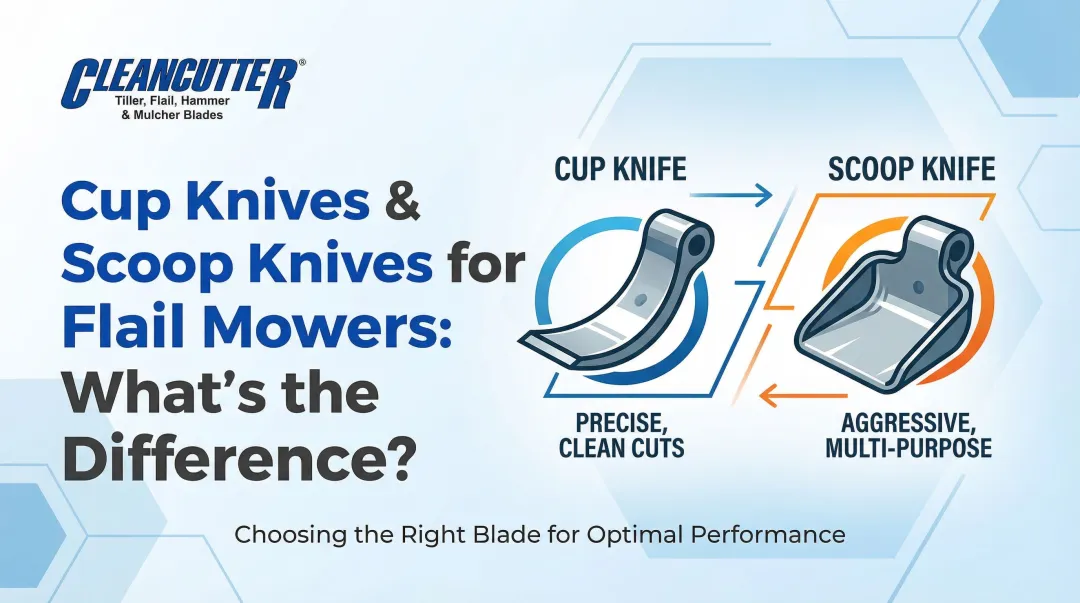
Y-blades are the most common flail type. Shaped like an extruded "Y," these blades are designed for cutting grass, weeds, and light brush. They deliver a fine mulching action and are well-suited for regular maintenance on pastures, roadsides, and parks. Because they're lighter than hammer blades, Y-blades require less engine power to spin and offer better fuel efficiency.
Best for: Turf, pasture, and roadside grass maintenance
Limitation: Wear faster in rocky or woody terrain
Hammer Blades (Heavy-Duty Flails)
Hammer blades are thick, impact-resistant flails engineered for cutting woody brush, dense shrubs, and small saplings. Their mass and geometry allow them to absorb impact from hard material without bending—making them the preferred choice for forestry prep and land clearing. Forged hammer blades excel at pulverizing thick brush but consume more fuel due to their weight.
Use hammer blades for thick brush, woody stems, saplings, and land clearing. Keep in mind they draw more engine power and leave a rougher finish on fine turf—using them for standard grass maintenance shortens blade life faster than necessary.
T-Blades and Finish Blades
T-shaped and finish-style blades are designed for precision cutting where surface appearance matters—orchards, vineyards, and turf management. These blades shear more cleanly than hammer or Y-blades but are not suited for heavy brush or rough terrain.
They're the right choice for orchards, vineyards, and managed turf—anywhere a clean, uniform cut matters more than raw cutting power.
Blade Hardness Grades and Coating Technologies
Beyond blade shape, material hardness determines how long blades last before replacement. Three grades are common in the market:
- Plain steel — economical upfront, wears faster in abrasive conditions
- Hard-faced — wear-resistant overlay on contact edges extends service intervals
- Coated — additional abrasion protection suited to sandy or gritty soils
Tungsten carbide inserts (such as SEPPI's MINI DUO hammers) significantly outlast standard steel in abrasive conditions, reducing replacement frequency in rocky or gritty terrain.
Clean Cutter has supplied replacement flail blades for brands including Alamo-Mott, Rhino, Loftness, Maschio, and Seppi for over 60 years. Their catalog covers Plain, Hard-Faced, and Super-Koated grades, with a cross-reference system that makes matching blades to your specific mower model straightforward.
Key Specs to Match a Flail Mower to Your Tractor
Matching the wrong mower to a tractor is the most common purchasing mistake. It results in either underpowered performance (bogging down, poor mulch quality) or purchasing more machine than the tractor can safely drive. Evaluate four specs before you buy.
PTO Horsepower Requirements
Flail mowers are rated by the minimum PTO HP required—not gross engine HP. PTO horsepower is typically 10% to 20% lower than gross engine horsepower due to transmission and hydraulic losses. For example, a tractor rated at 51.5 gross engine HP may deliver only 41.2 PTO HP.
HP requirements by cutting width:
- 48"–60" decks: 20–30 PTO HP
- 60"–72" decks: 25–35 PTO HP
- 72"+ decks: 35–80+ PTO HP (varies significantly by duty rating)
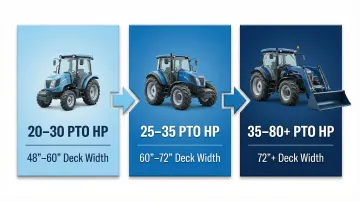
Always verify the tractor's PTO HP rating (not engine HP) and cross-reference with the mower manufacturer's stated minimum.
PTO Speed: 540 vs. 1000 RPM
Most compact and utility tractor flail mowers operate at 540 RPM PTO speed, which is standard on tractors up to roughly 75 HP. Larger mowers designed for 100+ HP tractors may require a 1000 RPM PTO connection.
Using the wrong PTO speed underspeeds or overspeeds the rotor, causing poor cut quality or mechanical damage. Running a 540 RPM implement on a 1000 RPM shaft can shear blade pins—turning heavy steel flails into high-energy projectiles and destroying the gearbox in the process.
How to verify: Check your tractor's spline count:
- 540 RPM: 1-3/8" 6-spline shaft
- 1000 RPM: 1-3/4" 20-spline shaft
Cutting Width and Working Width
Wider decks cover more ground per pass but demand more HP and can create stability issues on slopes.
Recommended deck sizes by tractor HP:
- 25–40 HP tractors: 48"–60" deck
- 50–75 HP tractors: 60"–84" deck
- 75–100+ HP tractors: 72"–96"+ deck
Some operators prefer slightly narrower decks to maintain tractor stability on uneven terrain, even if their tractor has sufficient power for a wider unit.
Mounting Type and 3-Point Hitch Category
Most tractor flail mowers connect via the 3-point hitch. Category 1 is standard for compact tractors (20–50 HP), while Category 2 is standard for utility tractors (40–100 HP). Front-mount options exist for visibility-critical work; side-offset mowers are used for ditch and fence line work.
Confirm your tractor's hitch category before ordering—adapters add complexity and can affect implement geometry.
How We Chose These Flail Mower Brands
These brands were evaluated based on compatibility with a broad range of tractor HP classes, parts availability in the North American market, track record with agricultural and landscaping operators, and long-term serviceability. Brands that lacked verifiable U.S. dealer presence or replacement part infrastructure were excluded.
That selection process was shaped partly by the mistakes buyers make most often. This guide helps you avoid:
- Sizing up to a mower built for a larger tractor, which causes chronic underpowering
- Choosing on purchase price alone without checking ongoing blade replacement costs
- Ignoring PTO speed requirements until after the equipment is already on-site
Build quality and blade material grade were weighted heavily for a straightforward reason: the rotor drum and blades absorb the most operational stress of any component on the machine. Brands with documented replacement part programs — including cross-compatible aftermarket blade suppliers — received preference over those with limited parts availability after the sale.
Conclusion
Selecting the right flail mower means getting three things right:
- Choosing a brand that fits your use case and support expectations
- Matching HP and PTO requirements to your tractor's actual output
- Picking the blade type suited to the material you cut most often
Blade wear is inevitable. The real long-term cost of a flail mower isn't the purchase price—it's how often blades need replacing and whether quality replacements are available for your specific model.
Clean Cutter stocks replacement flail blades for major brands including Alamo-Mott, Rhino, Loftness, Maschio, and Seppi—available in Plain, Hard-Faced, and Super-Koated grades. An OEM cross-reference system makes it straightforward to find the right blade for your model.
Contact Clean Cutter: sales@cleancutter.com | (800) 345-2335
Frequently Asked Questions
What size flail mower for 35 hp tractor?
A 35 HP tractor is best matched to a flail mower with a 48"–60" cutting width. Confirm actual PTO HP output (typically 85–90% of engine HP, or roughly 30–32 PTO HP) and cross-reference with the specific mower brand's minimum HP requirement before purchasing.
How much HP do you need to run a flail mower?
HP requirements vary by cutting width and material. Light grass mowing at 48"–60" typically requires 25–40 PTO HP, while heavy brush and wider decks require 50 HP or more. Always match PTO HP (not gross engine HP) to the mower manufacturer's stated minimum.
What PTO speed is required for a flail mower?
Most compact and mid-range tractor flail mowers require a 540 RPM PTO connection, while heavy-duty models designed for larger tractors may require 1000 RPM. Using the incorrect PTO speed will affect rotor performance and can cause damage.
What is the best flail mower for a compact tractor?
Brands like Rhino and Maschio are well-suited for compact tractors, with model ranges spanning 25–50 HP. Buyers should prioritize Category 1 hitch compatibility and a cutting width of 48"–60" for tractors in the 25–40 HP class.
Which flail mowers are made in the USA?
Alamo-Mott, Rhino, and Loftness are U.S.-based manufacturers. American-made mowers typically offer stronger domestic dealer networks and parts availability—reducing downtime for commercial operators.
How often should flail mower blades be replaced?
Blade replacement frequency depends on material type, soil conditions, and blade grade. Plain steel blades in rocky or sandy conditions may need replacement after 50–100 hours of use, while hard-faced or coated blades can extend service intervals significantly, according to Farmry's flail mower maintenance guide. Regular inspection after each use is the best practice.