Introduction
Flail mower owners often face a confusing parts catalog: cup knives and scoop knives look similar, carry similar names, but behave differently in the field. Picking the wrong one means more wear, worse cut quality, and faster blade replacement cycles.
Both blade types serve distinct purposes across vegetation types and terrain. Understanding the difference helps operators reduce downtime, extend blade life, and get cleaner results — and this guide covers exactly how to tell them apart and when to use each.
At typical operating speeds of 1,500 to 2,200 RPM, even a minor 35-gram weight discrepancy generates over 22 kg of centrifugal force, hammering bearings and cutting bearing life by 30% or more. Getting the blade selection right isn't just a performance call — it directly protects your drivetrain.
Key Takeaways
- The concave face on cup knives creates a lift-then-cut action — purpose-built for mulching and processing heavy vegetation
- Scoop knives use an open, angled profile to move material out fast, making them the better fit for grass and lighter brush where a clean finish matters
- If your mower will handle overgrown fields or dense brush, cup knives will outlast and outperform scoop knives in those conditions
- For routine cutting on maintained pastures or roadsides, scoop knives deliver cleaner results with less material buildup
- Blade hardness grade (plain, hard-faced, or coated) matters as much as shape for long-term durability
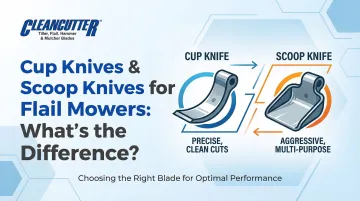
Cup Knives vs. Scoop Knives: Quick Comparison
| Feature | Cup Knives | Scoop Knives |
|---|---|---|
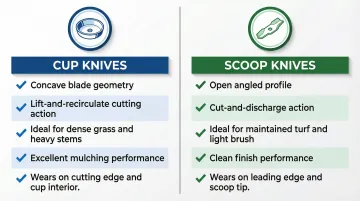
| Blade Geometry | Concave, curved (cupped) face | Open, angled profile |
| Primary Cutting Action | Lifting and recirculating | Cutting and discharging |
| Ideal Vegetation Type | Dense grass, overgrown pastures, heavy stems | Maintained lawns, light brush, turf |
| Mulching Performance | Excellent – recirculates material for finer particles | Moderate – prioritizes clean discharge |
| Typical Wear Pattern | Cutting edge and inside cup surface | Leading edge and scoop tip |
| Common Applications | Pasture renovation, orchard floors, roadside mulching | Landscaping, parks, sports fields, orchards |
Both blade types are available as direct replacement parts for a wide range of flail mower brands including Alamo-Mott, Rhino, Loftness, Maschio, and others.
What Are Cup Knives for Flail Mowers?
Cup knives use a concave, curved blade face to generate a lifting-and-cutting action. As the rotor spins, the cup shape engages material from below and pulls it into the cutting zone.
How the Cup Shape Works
The concave profile generates aerodynamic updraft (vacuum effect) that lifts matted or wheel-tracked vegetation prior to severing. This suction keeps vegetation upright for a more consistent cut and channels material into the blade edge more aggressively than a flat blade. Manufacturers note that this vacuum action is highly effective at lifting foliage off the ground and up into the shredder.
Ideal Use Cases
Cup knives excel in:
- Dense grass and overgrown pastures where trampled vegetation needs to be lifted before cutting
- Roadside and highway mowing where consistent rotor balance across many blades is critical for vibration-free operation
- Orchard floor management where chipped woody and green material improves soil water retention and biological activity without imported compost
- Pasture renovation with thick stem material where the lifting action pulls lodged grass upright for clean severing
Mulching in place also cuts labor: no hauling, and the on-site organic matter returns carbon directly to the soil.
Durability Characteristics
Cup knives typically show wear first on the cutting edge and the inside of the cup. Heavier steel grades or hard-faced options extend service life in abrasive or rocky conditions. Replacement is needed when edge rounding or chipping becomes visible, or when the blade length has reduced significantly from the original spec.
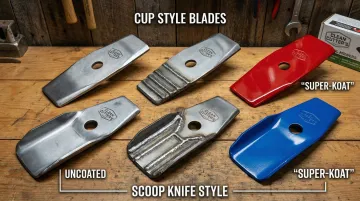
Blade variations: Cup knives may come in single- or double-edged configurations. Hardness grade—plain steel versus hard-faced versus coated options like Clean Cutter's Super-Koat—affects how quickly the cup edge degrades under heavy use.
What Are Scoop Knives for Flail Mowers?
Scoop knives feature an angled, open-profile blade shape that differentiates them from cup knives. The "scoop" refers to a front-edge geometry designed to catch and cut vegetation while directing discharge efficiently rather than recirculating material like a cup.
How the Scoop Profile Works
The scoop profile trades some of the aggressive lifting action of a cup knife for more efficient lateral discharge. This reduces re-cutting of material and can lower fuel load on the tractor PTO under lighter mowing conditions. Equipment manufacturers specifically designate scoop knives for fine/finish cutting applications, noting their ability to deliver a manicured appearance on grassy material.
Ideal Use Cases
Scoop knives are preferred for:
- Maintained lawns and turf where a clean, consistent cut finish matters more than maximum mulch particle reduction
- Orchard floor grooming requiring a tidy appearance
- Parks and sports turf perimeter maintenance
- Light brush along drainage ditches
- Landscaping contractors who need a tidy finish for client properties
- Golf course and sports field edges where cut quality is critical
- Any application where excessive mulching or soil disturbance would be undesirable
When paired with a rear roller, the open discharge of the scoop knife allows efficient processing while the roller stripes the turf, providing a highly aesthetic finish that rivals rotary finish mowers.
Durability Characteristics
Scoop knives typically wear on the leading edge and scoop tip. Because scoop knives are often used in lower-debris environments, plain or lightly coated steel grades may suffice—though hard-faced options are available for mixed-terrain use. Scoop knife profiles also vary by manufacturer—some are more aggressively angled than others. Always verify hole pattern, blade length, and mounting bolt specs before ordering for a specific rotor.
Cup Knives vs. Scoop Knives: Which One Should You Choose?
The right blade comes down to five variables:
- Vegetation density and type
- Desired finish quality
- Mulching versus discharge priority
- Terrain abrasiveness
- How often you're willing to replace blades
Situational Recommendations
Choose cup knives when:
- The job involves thick or tall vegetation
- Mulching is a goal (returning organic matter to soil)
- The mower operates in rougher conditions where the cup's aggressive engagement helps productivity
- You're managing overgrown pastures, roadside vegetation, or orchard floors
Choose scoop knives when:
- Cut-finish quality matters (parks, sports fields, high-visibility areas)
- Vegetation is lighter and well-maintained
- Efficient discharge reduces re-mowing passes
- You need a manicured appearance without excessive mulch buildup
The Blade Grade Decision
Once you've settled on knife style, the next decision is grade. Hardness grade significantly affects how long the blade holds its cutting profile under your specific conditions. Clean Cutter offers both blade types in plain, hard-faced, and Super-Koat coated grades to match the intensity of the application.
The Super-Koat option provides enhanced wear resistance for operators who want longer intervals between replacements. In abrasive soils and gravel roadsides, coated parts can last as much as three times as long as uncoated parts.
Real-World Scenarios
Cattle Rancher Managing Overgrown Pastures
A rancher working dense grass and woody stems needs aggressive mulch capability that handles stems and returns organic matter to soil. Cup knives are the better fit here. For rocky pasture ground, upgrading to hard-faced or Super-Koat blades prevents premature edge degradation and extends replacement intervals from 50-100 hours to 150-300 hours.
Landscaping Contractor Maintaining Orchard Floors
A landscaping contractor maintaining orchard floors and roadside grass for a municipal client needs cleaner discharge and finish quality. Scoop knives deliver the tidy appearance required while efficiently moving material out of the cutting zone. For gravel shoulders, a hard-faced grade prevents premature wear and maintains cut quality throughout the season.
Clean Cutter's cross-reference catalog makes it easy to find cup or scoop knife replacements compatible with major mower brands like Alamo-Mott, Rhino, Loftness, and Maschio. Contact the sales team at (800) 345-2335 or sales@cleancutter.com to source the right replacement blades for your equipment.
Conclusion
Cup knives and scoop knives each solve a specific problem: heavy mulching and aggressive vegetation engagement for cup knives, clean finish and efficient discharge for scoop knives. Getting that match right is the fastest way to reduce equipment strain and avoid unnecessary wear costs.
Blade type is only half the equation. Three factors determine long-term performance:
- Hardness grade — matched to your soil conditions and vegetation density
- Replacement schedule — consistent swaps maintain rotor balance and cutting efficiency
- Operating awareness — at speeds exceeding 2,000 RPM, worn or mismatched blades accelerate bearing damage and vibration
Clean Cutter's replacement catalog covers cup and scoop knives in plain, hard-faced, and Super-Koat grades across major OEM cross-references, so you can spec the right blade for the job without guesswork.
Frequently Asked Questions
Can cup knives and scoop knives be used on the same flail mower rotor?
Mixing blade types on the same rotor is not recommended because the different cutting actions and weights throw off rotor balance, increasing vibration and wear on bearings. Replacing all blades with the same type maintains consistent performance and protects your equipment.
What's the difference between a cup knife and a hammer blade on a flail mower?
Hammer blades are heavier, blunt-impact tools designed for woody brush and heavy debris up to 2 inches in diameter. Cup knives are edge-cutting blades shaped for grass, weeds, and light brush up to 1 inch. They target entirely different vegetation types and are not interchangeable.
Are cup knives or scoop knives better for mulching?
Cup knives generally produce finer mulch because the concave face recirculates material for more passes through the cutting zone. Scoop knives are optimized for cleaner discharge rather than particle reduction, delivering cleaner surface finish rather than fine particle reduction.
How do I know when to replace flail mower cup or scoop knives?
Replace the full blade set when you notice edge rounding or chipping, increased operating vibration, uneven cut quality, or a significant drop in blade length from the original spec. Replacing as a set keeps the rotor balanced.
Does blade coating (like hard-faced or Super-Koat) work the same on both cup and scoop knives?
Yes, hardness coatings apply to both blade types with the same goal: extending cutting edge life. The benefit is most pronounced in abrasive or high-debris conditions, where coated blades can last up to three times longer than bare steel.
How do I find the right cup or scoop knife replacement for my flail mower brand?
Use a parts cross-reference tool or catalog that matches by mower manufacturer and model. Check hole pattern, blade dimensions, and mounting hardware specs to ensure compatibility before ordering. Clean Cutter's catalog cross-references major brands including Alamo-Mott, Rhino, Loftness, and Maschio.