Introduction
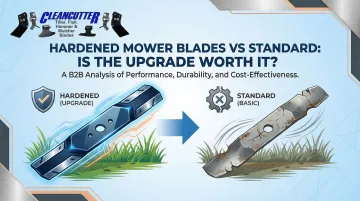
Blade replacement is one of the most predictable, and costly, line items for flail mower and rotary tiller operators. For commercial crews and agricultural operators, the decision between standard and hardened blades at replacement time can swing seasonal maintenance budgets by hundreds or even thousands of dollars. Yet many operators default to whichever blade is cheapest upfront, never calculating the true cost per acre or per season.
The core tension is simple: standard blades cost less at checkout, but hardened blades deliver longer service life and fewer mid-season replacements. The "right" answer isn't universal. It depends entirely on your operating conditions, usage intensity, and terrain. A municipal crew mowing grass-covered roadsides faces fundamentally different economics than an agricultural operator running a flail through rocky, debris-strewn fields.
This article breaks down blade composition, real-world performance differences, total cost-of-ownership factors, and scenario-based decision criteria to help you choose the blade grade that actually saves money for your operation.
Key Takeaways
- Standard blades (45-52 HRC) cost less upfront but wear out faster in abrasive or debris-heavy conditions
- Hardened blades reach 55-65+ HRC through heat treatment, hard-facing, or advanced coatings — and hold their edge significantly longer
- The upgrade pays off for commercial operators and rocky terrain work, often delivering 2.5-4× longer blade life
- For low-frequency or light-duty agricultural use, standard blades typically offer better economics
- Total cost comparison must factor in replacement frequency, labor, and downtime — not just the per-blade price
Hardened vs. Standard Mower Blades: Quick Comparison
| Attribute | Standard Blades | Hardened Blades |
|---|---|---|
| Upfront Cost | Low ($7-$15 per blade) | High ($15-$55+ per blade, depending on grade) |
| Steel Composition | Plain carbon (65Mn) or low-alloy (60Si2Mn); 45-52 HRC | Heat-treated boron, hard-faced with WC/CrC overlay, or coated; 55-65+ HRC |
| Edge Retention | Dulls quickly in sand/rock; 7.08g mass loss per acre in abrasive soil | 2.5-4× longer wear life; 2.84g mass loss per acre with hard-facing |
| Sharpening | Easy with standard equipment | May require specialized tools for hard-faced edges |
| Ideal Use | Clean turf, light-to-moderate use, residential settings | Commercial fleets, rocky/abrasive terrain, flail mowers, tillers in stony soil |
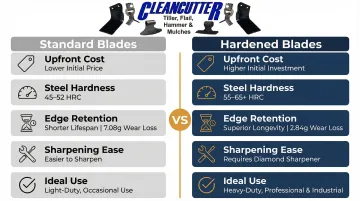
Hardened blades come in multiple grades—heat-treated, hard-faced with overlay, and coated variants—each with a distinct performance ceiling and price point. The sections below break down which grade fits which conditions.
What Are Standard Mower Blades?
Standard mower blades are typically stamped or forged from plain carbon steel (such as 65Mn) or low-alloy spring steel (such as 60Si2Mn, containing approximately 0.60% carbon, 1.5–2.0% silicon, and 0.6–0.9% manganese). After standard quenching and tempering, these blades achieve a hardness range of 45–52 HRC. They are the default blade type shipped with most residential and light commercial mowers, designed to balance cutting performance with cost and ease of maintenance.
Core operational benefits:
- Low purchase cost (typically $7–$15 per blade for residential equivalents)
- Straightforward sharpening with standard bench grinders or files
- Broad availability across most equipment manufacturers and models
- Adequate performance for well-maintained turf with minimal debris, rocks, or abrasive soil
- High shock absorption without brittleness
Standard blades lose their edge rapidly in abrasive conditions. In controlled field trials using dry, sandy soils with crop stubble, standard heat-treated steel blades exhibited severe wear, losing an average of 7.08 grams per acre.
The wear begins at the outer end of the leading edge and moves inward, changing the blade's profile to a blunt curvature that reduces cutting efficiency. The result: more frequent sharpening cycles, faster replacement, and higher total costs for high-use operators.
Use Cases of Standard Blades
Standard blades fit best in:
- Residential settings with maintained turf
- Light-use scenarios (seasonal mowing, small acreage)
- Clean loam or clay soils with minimal rock or gravel content
- Situations where the operator prefers easy on-site sharpening with basic tools
- Budget-constrained operations where lower upfront cost is the primary driver
What Are Hardened Mower Blades?
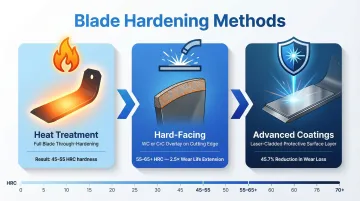
Hardened mower blades have undergone one or more processes to increase surface and/or core hardness beyond standard steel. The three primary hardening approaches are:
- Through-hardening or heat treatment applied to the full blade
- Hard-facing, where a wear-resistant alloy or carbide material is applied as an overlay to the cutting edge
- Advanced coating technologies that bond a protective layer to the blade surface to resist abrasion
Hardness is typically measured on the Brinell (HBW) or Rockwell (HRC) scale. Harder blades hold their cutting edge under conditions that would quickly dull standard steel.
Hard-Facing Technology
Hard-faced blades feature a deposited overlay—often tungsten carbide (WC) or chromium carbide (CrC)—on the leading edge or blade face. This overlay is significantly harder than the base steel (achieving 55-65+ HRC surface hardness, with tungsten carbide hard phases reaching up to 2500 HV microhardness) and acts as a sacrificial wear layer.
Hard-facing deposits a wear-resistant alloy onto a softer, tougher base metal using welding processes like SMAW, GMAW, or FCAW. The microstructure consists of extreme high-hardness carbide particles embedded in a ductile matrix.
Field data backs up the durability gains. In a 50-acre test, standard blades lost 7.08g per acre. Blades hard-faced with a 12% Chromium (12HCr) alloy lost only 2.84g per acre, producing a Wear Resistance Index (WRI) of 2.5 — the hard-faced blade lasted 2.5 times longer.
Coating Technologies
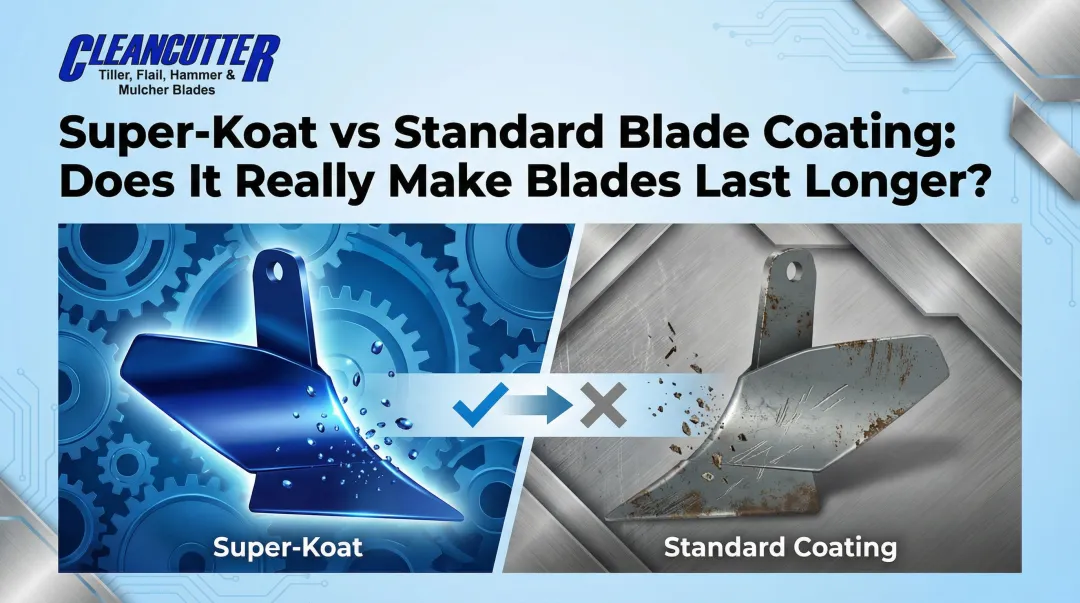
Some manufacturers use proprietary surface coatings that bond a protective layer across the blade surface to extend wear resistance and reduce friction. For example, Clean Cutter's Super-Koat technology applies a specialized coating that differs mechanically from hard-facing. Advanced coatings like laser-cladded 35% Tungsten Carbide (WC) applied to 65Mn substrates have reduced field wear mass loss to 2.259g compared to 4.164g for uncoated blades: a 45.7% reduction over a 3-hour trial.
Coatings can also provide corrosion resistance in wet or chemical-heavy environments, making them valuable for operators working in high-moisture conditions or near fertilizers and pesticides.
Operational Benefits
Hardened blades deliver:
- Longer intervals between replacement (often 2.5-4× standard blade life)
- More consistent cut quality over time (less degradation between sharpenings)
- Reduced total downtime for blade swaps
- Better performance in the abrasive conditions that destroy standard blades quickly
Trade-Offs
- Higher per-blade purchase price (often 2-3× standard blades)
- Potentially harder to re-sharpen without appropriate equipment (especially for hard-faced edges)
- More brittle than standard blades: hard-faced edges are more prone to chipping on large solid obstacles, where a more ductile standard blade would flex rather than crack
Use Cases of Hardened Blades
Those trade-offs matter less when conditions are consistently demanding. Hardened blades make the most sense for:
- Commercial landscaping fleets running mowers daily
- Agricultural operators using flail mowers in rough, rocky, or debris-laden fields
- Roadside vegetation management where buried rocks and debris are a constant hazard
- Any operation where unplanned downtime from premature blade failure carries significant cost
- Tiller applications in abrasive or stony soils
Hardened vs. Standard: Which Is Right for Your Operation?
The decision isn't about which blade is technically superior—it's about matching blade grade to actual operating conditions and usage economics. Here are the key decision factors operators should assess before choosing.
Factor 1: Usage Intensity and Frequency
A small farm operation running a tiller a few hours a week faces fundamentally different wear economics than a commercial crew running equipment 6-8 hours a day. Higher intensity use accelerates wear on standard blades disproportionately, making the cost premium of hardened blades easier to recoup.
Decision rule: If you're operating commercially or running equipment more than 20 hours per week, hardened blades almost always pay for themselves within a season.
Factor 2: Terrain and Soil Conditions
Soil composition is the ultimate dictator of blade life. According to USDA Soil Survey classifications, soils with high gravel, cobble, or sand content present severe abrasion risks. Agricultural engineering reviews confirm that the wear rate of sandy soils is measurably higher than that of loamy and clay soils, and wear increases with stone content and size.
When operating in sandy loam, gravelly terrain, or fields with hidden rocks, standard blades degrade too rapidly to be economical. The quartz and sand particles act as a grinding medium between the blade and the earth, causing three-body abrasion that strips material from the cutting edge.
Bottom line: If your terrain includes sand, gravel, or frequent rock strikes, hardened or hard-faced blades are essential.
Factor 3: Total Cost of Ownership vs. Upfront Price
Walk through the logic of calculating true blade cost:
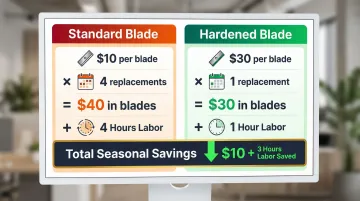
(Cost per blade) × (Number of replacements per season) + (Labor time for each swap) = Total seasonal cost
Example calculation:
- Standard blade: $10 each, replaced 4 times per season = $40 in blades + 4 hours labor
- Hardened blade: $30 each, replaced 1 time per season = $30 in blades + 1 hour labor
Even though the hardened blade costs 3× more upfront, the total seasonal cost is lower because replacement frequency drops by 75%. Add in the value of reduced downtime and more consistent cut quality, and the hardened blade becomes the clear winner.
Rule of thumb: Calculate your actual replacement frequency over a full season. If standard blades require more than 2 replacements, hardened blades will likely reduce total cost.
Factor 4: Equipment Type and Blade Compatibility
Flail mowers used in agricultural and roadside applications face far more debris impact than lighter-duty rotary equipment. Flail mowers use swinging knives or hammers rotating on a horizontal shaft—built to cut vegetation but regularly striking hidden rocks, metal guard rails, and concrete structures at high velocities.
Because of this high-impact environment, flail blades require high toughness. Hard-faced blades are especially well-suited here, balancing extreme surface hardness with a ductile core that absorbs shock.
Rotary tillers engage directly and continuously with the soil, facing constant three-body abrasion from sand and gravel. For tiller applications in stony soils, extreme surface hardness (like WC overlays) is highly beneficial, as the impact forces are generally lower and more consistent than those faced by roadside flail mowers.
The call: For flail mowers in debris-heavy terrain, choose hard-faced blades. For tillers in rocky soil, choose hard-faced or coated blades. For clean-field rotary mowing at moderate frequency, standard blades are sufficient.
Situational Recommendation Summary
Choose standard blades if:
- Usage is light-to-moderate
- Terrain is clean loam or clay
- Budget is the primary concern
- Easy resharpening is a priority
Choose hardened blades if:
- Operating commercially or high-frequency use
- Rocky, sandy, or abrasive terrain
- High replacement frequency with standard blades
- Running flail/tiller equipment under demanding conditions
When the Upgrade Pays Off (and When It Doesn't): Real-World Scenarios
Scenario 1: Commercial Flail Mower Operator in Mixed-Terrain Fields
A commercial landscaping operation uses flail mowers along roadsides and field edges with hidden rocks and debris. The operator was replacing standard blades every 2-3 weeks due to rapid dulling and occasional impact damage, resulting in frequent downtime and mounting labor costs.
After switching to tungsten carbide hard-faced blades, replacement intervals extended to 8-10 weeks. Aftermarket data confirms this pattern: upgrading from standard boron steel flails to tungsten carbide hard-faced blades typically yields 3-4× greater wear life. The hard-faced blades hold their edge far longer, preventing the blunt-force tearing that strains tractor PTOs and degrades cut quality.
Takeaway: For operators in this situation, the hardened blade premium is recouped within a season, and the reduction in downtime delivers additional value beyond direct cost savings.
Scenario 2: Light-Duty Agricultural Mowing on Clean, Flat Ground
Not every operation justifies the upgrade. Consider a small farm operation mowing maintained pasture on flat, debris-free ground — consistent grass, no hidden rock hazards, moderate seasonal use. Standard blades hold up well in these conditions, with replacement intervals stretching a full season or longer. The premium cost of hardened blades simply doesn't return enough value when wear rates are already low.
Takeaway: Know your environment before upgrading. If your terrain is gentle and usage is light, standard blades are the smarter choice.
Scenario 3: Tiller Operator in Rocky Soil
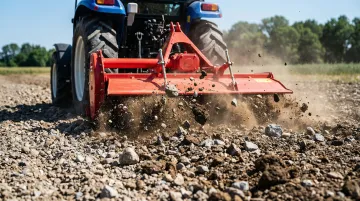
An agricultural tiller user working stony or gravelly ground faced rapid wear and chipping of standard tiller blades, causing uneven tillage and frequent downtime. In a 2025 study evaluating rotary tillage blades in abrasive, dry sandy soils, researchers applied a 35% WC (Tungsten Carbide) Fe60 composite coating via laser cladding to 65Mn substrates. After 3 hours of harsh field operation, the uncoated standard blades suffered an average wear loss of 4.164 grams. The laser-cladded blades lost only 2.259 grams—a 45.7% reduction in material loss.
Takeaway: Hardened or coated blades hold up significantly better in rocky tillage conditions, reducing both replacement costs and the quality inconsistency caused by worn blades.
For operators ready to evaluate blade options across standard, hard-faced, and Super-Koat grades, Clean Cutter's catalog covers flail and tiller blades cross-referenced against major equipment brands — with grades matched to operating conditions, from light-duty plain blades to heavy-wear tungsten carbide hard-faced options. Use their cross-reference system to find the right blade grade for your specific equipment and conditions. Contact Clean Cutter at (800) 345-2335 or sales@cleancutter.com for technical guidance and product recommendations.
Conclusion
Neither standard nor hardened blades are universally the right answer. Standard blades are a practical, cost-effective choice for light-duty and residential use where operating conditions are gentle and replacement frequency is low. Hardened blades—whether heat-treated, hard-faced, or coated—deliver real returns in commercial, agricultural, and demanding terrain applications where the reduced replacement frequency and maintained cut quality more than offset the higher per-blade price.
Before deciding, operators should ask three questions:
- What is my true cost-per-season? Per-blade price tells only part of the story — replacement frequency and downtime determine the real number.
- What are my actual terrain conditions? Rocky, root-heavy, or abrasive soil changes the math quickly in favor of harder blades.
- How much does cut quality consistency matter? For commercial operators, degraded cut quality between replacements has its own cost.
For light residential use, standard blades hold up fine. For commercial and agricultural operators running tough ground, hardened blades are frequently the highest-return maintenance upgrade available.
Frequently Asked Questions
Are lawn mower blades heat treated?
Yes. Many blades—particularly those marketed as "hardened"—undergo heat treatment to increase steel hardness and improve wear resistance. Standard OEM blades typically use mild or low-alloy steel without specialized heat treatment, while upgraded blades use through-hardening or surface hardening processes to achieve 45-55 HRC or higher.
What is the best blade hardness for mower blades?
For most agricultural blades, 45-55 HRC is the target range—soft enough to absorb impact without cracking, hard enough to hold an edge. Hard-faced overlays can reach 55-65+ HRC, but require a ductile core to prevent chipping on rock strikes.
What are the toughest lawn mower blades?
The toughest blades pair a ductile steel body with a hard-faced or carbide-overlay cutting edge. Clean Cutter's hard-faced and Super-Koat blades are built specifically for this balance—designed for commercial and agricultural flail mower work where abrasion and impact resistance both matter.
Are laser edge blades worth it?
Yes, for continuous commercial or harvesting operations. Field tests show laser edge blades can maintain a sharp cutting shape for over 76 hours, reducing wear by up to 67% compared to standard blades. For light-duty or infrequent use, the premium is harder to justify.
What type of lawn mower blades are best?
"Best" depends on two factors: blade shape/lift (standard, high-lift, mulching) for cut style and discharge method, and blade material/hardness grade (standard vs. hardened) for durability under operating conditions. The best blade matches both the mower's design requirements and the operator's terrain and usage intensity.
Which is better, 440 or 420 steel for mower blades?
440 steel achieves higher hardness (58-60 HRC vs. 50-55 HRC for 420) and holds an edge longer under abrasion. For agricultural flail mowers that take rock impacts, though, 420-profile steel's toughness is generally the better trade-off—440's higher hardness makes it more brittle under sudden shock loads.