Introduction
Tiller and flail blades take a beating—every season they're dragged through rocks, compacted soil, roots, and debris. For operators and equipment managers, blade longevity isn't a minor detail; it's a direct line to uptime, operating costs, and seasonal productivity.
Equipment downtime costs up to $2,400 per day during planting season, and replacing a full set of 88 flail mower blades can consume over 3 hours of intensive labor.
So when it comes to blade finish options — standard coated versus Super-Koat — does paying more for a specialized coating actually extend blade life, or is it just premium packaging? The answer depends on your soil type, use intensity, and replacement budget. This post breaks down what each coating is, how it performs under real agricultural conditions, and which option makes sense for your operation.
Key Takeaways
- Super-Koat is Clean Cutter's proprietary brazed diamond coating, bonding harder and more uniformly to blade steel than standard paint or powder coat
- Standard blade coating offers basic corrosion protection but provides minimal wear resistance under abrasive tillage conditions
- Super-Koat suits high-frequency use, abrasive soils, and operations where frequent blade swaps drive up downtime costs
- For light-duty or occasional use, standard coated blades are the practical choice when upfront cost is the priority
- Base steel quality and hardness grade matter—no coating compensates for softer underlying blade material
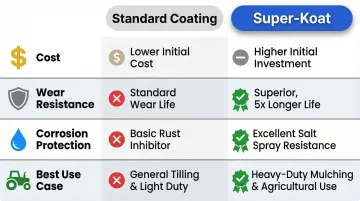
Super-Koat vs Standard Blade Coating: Quick Comparison
| Factor | Standard Coating | Super-Koat |
|---|---|---|
| Cost | Lower upfront cost; entry-level option | ~30% higher per blade; offset by longer service life |
| Wear Resistance | Guards against rust and surface oxidation; limited abrasion resistance | Built for surface hardness and abrasion resistance under tillage stress |
| Corrosion Protection | Adequate for storage and moderate field conditions | Resists moisture, soil acids, and chemical exposure in farm environments |
| Best Use Case | Occasional use, lighter soils, budget replacement programs | High-hours operation, rocky or abrasive soils, demanding flail and tiller work |
What is Standard Blade Coating?
Standard blade coating in agricultural tiller and flail blades typically consists of painted or powder-coat finishes applied to the blade surface after forming and heat treatment. These coatings protect against rust during storage, transit, and field exposure. That protection, however, stops well short of the cutting edge.
During curing, powder coating and paint shrink away from sharp edges, leaving critical cutting tips with minimal film build. This makes blade edges vulnerable to immediate wear and creates corrosion entry points from the start.
Once that coating wears through at impact zones — blade tips, edges, bolt areas — the underlying steel faces the same abrasive conditions as an uncoated blade. Field trials show standard-painted blades lose 0.86 cm³/ha in dry, sandy soil, with paint stripped almost immediately upon soil contact.
Use Cases of Standard Blade Coating
Standard coating fits operations with:
- Light-duty or seasonal tiller use
- Scheduled blade replacement intervals regardless of wear
- Upfront blade cost as the primary purchasing factor
- Softer loam soils without significant rock content
These conditions suit standard coating well — but they represent a narrow slice of real-world field use. In high-RPM flail or tiller applications with rocky, sandy, or heavy clay soils, standard coatings wear through quickly at the cutting edge and bolt areas. Sandy soils increase wear rates by up to 67% compared to clay loams due to quartz micro-ploughing and three-body abrasion.
What is Super-Koat?
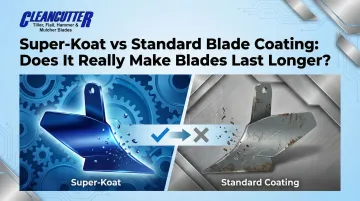
Super-Koat is Clean Cutter's proprietary coating technology, developed through over six decades of manufacturing tiller and flail blades. It's engineered specifically to extend blade service life beyond what standard paint or powder coatings can deliver in agricultural conditions.
The Engineering Principle
Super-Koat is not a cosmetic finish. It's formulated as a brazed diamond wear-resistant coating applied via vacuum isothermal heat treatment. Unlike spray-applied paint coatings that sit on the surface, Super-Koat bonds to the blade substrate more aggressively, maintaining protection at the highest-stress zones: cutting tips, leading edges, and bolt holes.
The wear data backs this up. HVOF-sprayed Tungsten Carbide (WC/Co) on rotary tiller blades showed a wear rate of 0.02 cm³/ha compared to 0.86 cm³/ha for uncoated blades, a 43x improvement. Proprietary brazed diamond processes like Super-Koat claim up to a 5x lifespan multiplier over standard coatings.
Corrosion and Chemical Resistance
Super-Koat protects against soil moisture, fertilizer residues, and crop acids that accelerate corrosion on standard-coated blades. Mild steel exposed to 63% ammonium nitrate solutions corrodes at 1,250 µm/year. Once standard paint is breached, these chemicals attack bare steel, causing pitting and structural weakness.
What Super-Koat Is Not
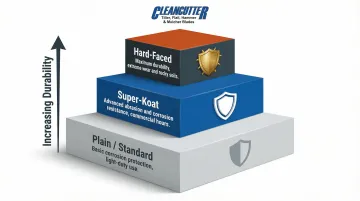
Super-Koat is a surface coating treatment — it improves abrasion and corrosion resistance but does not change the underlying steel hardness grade. For operations facing the most extreme wear conditions, Clean Cutter also offers Hard-Faced blades. The full product tier looks like this:
- Plain/Standard — basic corrosion protection for light-duty or short-season use
- Super-Koat — advanced abrasion and corrosion resistance for commercial-hours operations
- Hard-Faced — maximum durability for extreme wear conditions like rocky soils and heavy brush
Use Cases of Super-Koat
Super-Koat delivers the most value in:
- High-hours commercial operations
- Flail mower use in roadside or brush cutting where debris impact is constant
- Tiller use in rocky or sandy soils where abrasion accelerates blade thinning
- Operations where each blade change requires costly equipment downtime
Clean Cutter's Super-Koat blades are available across their full catalog, covering major equipment brands including Alamo-Mott, Rhino, Loftness, Seppi, and others. Operators can find Super-Koat versions of their current blade spec without switching blade geometry.
Super-Koat vs Standard Coating: Which is Better for Your Operation?
The right coating choice comes down to four factors: soil abrasiveness, seasonal operating hours, downtime cost per blade change, and whether you run continuous shifts or intermittent use.
Choose Standard Coating If:
- You're running a hobby farm or tilling occasionally
- Your soils are loam-based with little to no rock content
- Per-blade cost is the primary budget constraint
- You log fewer than 50 hours per season
Choose Super-Koat If:
- You're running commercial hours — consistent, high-use seasons
- Your ground has significant gravel, clay hardpan, or rock
- Every blade change means equipment downtime and lost productivity
- You're working sandy soils, where wear rates increase by 67%
The Hidden Cost of Under-Specifying
Choosing the cheapest coating in a high-wear application isn't just a blade cost issue—it creates compounding costs:
- Increased downtime for frequent blade changes
- Labor costs for replacement (3+ hours for full flail mower blade sets)
- Potential damage to blade holders and spindles from blades worn thin or broken prematurely
- Lost productivity during critical seasonal windows
Example cost comparison: A Super-Koat blade priced at $15.66 versus a standard blade at $12.06 represents a $3.60 premium (about 30%). If Super-Koat extends blade life by even 50% in abrasive conditions, the per-hour cost is lower, before factoring in reduced downtime.
What the Field Actually Tells You: Real-World Blade Wear in Agricultural Conditions
The Wear Mechanism
Unlike knife or saw blades, tiller and flail blades face multi-axis stress—they flex on impact, scrape against abrasive soil particles, and contact rocks and embedded debris at high rotational speed. This creates wear patterns at the blade tip and leading edge first, then progresses inward.
Dominant wear mechanism: Free-form abrasive wear, specifically two-body and three-body abrasion involving micro-cutting and micro-ploughing by hard soil particles like quartz and sand. Wear typically initiates at the outer end of the leading edge and moves inward toward the base.
Blade Failure Patterns
| Condition | Standard Coating | Super-Koat |
|---|---|---|
| Coating at stress points | Wears through early; bare steel exposed rapidly | Maintains adhesion under flex and impact |
| Paint/surface layer | Stripped immediately upon soil engagement | Durable layer delays substrate exposure |
| Net effect | Accelerated wear on unprotected steel | Substrate protected significantly longer |
Does Super-Koat Really Extend Blade Life?
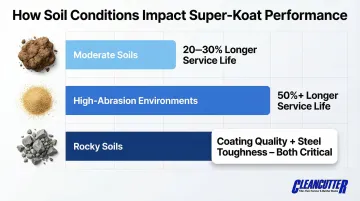
Yes—but the magnitude depends heavily on soil conditions:
- Moderate soils: The difference may be incremental (20-30% longer life)
- High-abrasion environments: Service intervals can extend 50% or more compared to standard-coated blades
- Rocky soils: Impact resistance becomes critical; both coating quality and base steel toughness matter
If your equipment runs on Alamo-Mott, Rhino, Loftness, Seppi, or other major brands, Clean Cutter stocks Super-Koat blades cross-referenced to your model. Call (800) 345-2335 or email sales@cleancutter.com to confirm the right spec before ordering.
Conclusion
Super-Koat is a purpose-engineered coating built specifically for agricultural blade applications where abrasion, impact, and field exposure are the main causes of blade wear. Standard coating performs adequately in light conditions but is not built for the stress levels of commercial or high-hours tilling and flail work.
Decision clarity:
- Standard coating suits light-duty operations or situations where upfront cost is the overriding constraint
- Super-Koat is the more cost-effective choice over a full season if you're replacing blades frequently, running rocky or abrasive soil, or can't afford downtime
Clean Cutter has manufactured tiller and flail blades since 1963. That history is what shaped Super-Koat into a field-tested solution, not a marketing add-on.
Frequently Asked Questions
What is the best coating for tiller and flail blades?
The best coating depends on operating conditions. Super-Koat is the recommended choice for high-wear, commercial, or abrasive-soil applications, while standard coating is sufficient for light-duty or infrequent use where upfront cost is the primary concern.
What is wear resistance in steel?
Wear resistance is a steel's ability to resist surface material loss from abrasion, impact, and friction. It is influenced by hardness (HRC rating), alloy composition, and any surface treatment or coating applied to the blade.
Is 45 HRC harder than 60 HRC?
No—HRC (Rockwell Hardness Scale C) increases with the number, so 60 HRC is harder than 45 HRC. Harder blades resist abrasion better but can be more brittle under heavy impact, which is why hardness grade selection balances toughness against wear resistance.
How long do Super-Koat tiller blades last compared to standard coated blades?
In rocky or sandy soils, operators typically see 50–100% longer service life with Super-Koat blades compared to standard-coated blades. Actual results vary by soil type and operating hours, but Super-Koat is specifically engineered to extend replacement intervals in abrasive conditions.
Does blade coating wear off over time in rocky or abrasive soil conditions?
Yes, all coatings eventually wear under sufficient abrasion — the rate depends on coating quality and adhesion. Super-Koat is formulated to maintain surface integrity longer than standard paint or powder coatings in agricultural tilling applications.
When should I choose hard-faced blades over Super-Koat blades?
Hard-faced blades are the appropriate choice for the most extreme wear conditions—very rocky soils, high-impact brush cutting, or applications where even Super-Koat blades are wearing faster than operationally acceptable. They represent Clean Cutter's highest-durability tier.