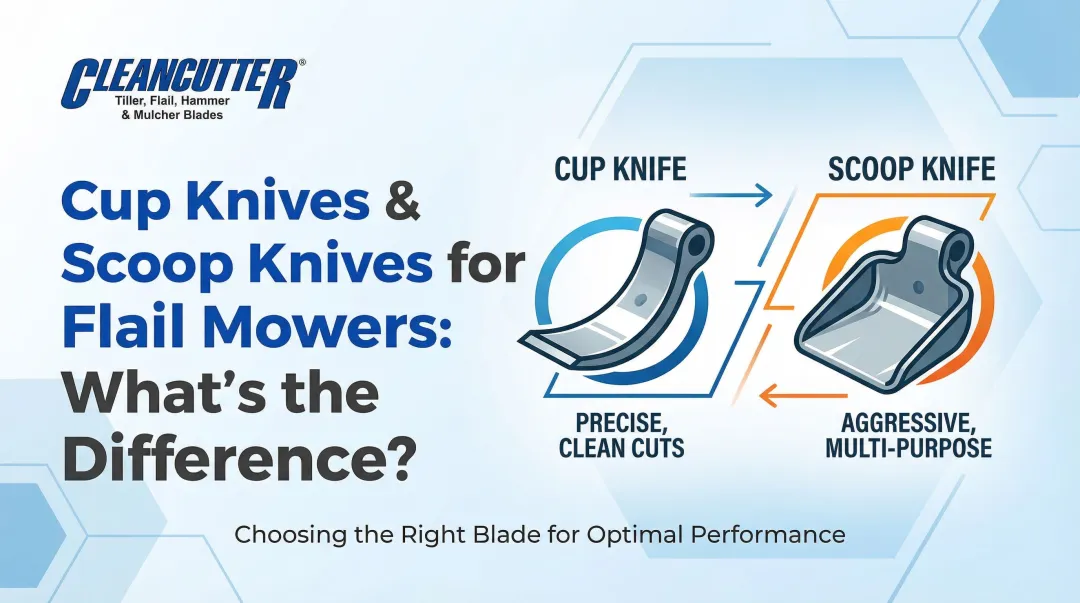

This guide covers what a flail mower is, how it works, what it's used for, and how to maintain the blades that keep these machines performing at their best.
Key Takeaways
- Flail mowers use swinging blades (called flails) on a rotating horizontal drum to cut and mulch vegetation
- Unlike rotary mowers, flails swing back on impact instead of throwing debris — a meaningful safety advantage
- Common uses: pasture maintenance, roadside clearing, ditch banks, overgrown brush
- Blade style (hammer, Y-blade, SideSlicer) and material hardness directly determine cut quality and how long blades last
What Is a Flail Mower?
A flail mower is a powered cutting implement that uses multiple small swinging blades—called flails, knives, or hammers—mounted on a horizontal rotating drum to cut and mulch heavy vegetation that standard lawn mowers cannot handle.
The name references the ancient agricultural hand tool used to thresh grain. The traditional flail consisted of a long handle connected to a shorter striking club by a flexible leather thong or chain hinge, allowing the beater to swing freely. The mower's blades work on the same principle, swinging outward from the drum under centrifugal force.
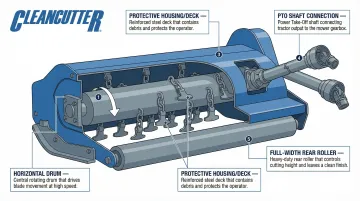
Key components include:
- Horizontal drum — the rotor that spins at high speed, driving blade movement
- Flail blades — individual cutting elements mounted via chain links or brackets, free to swing on impact
- Protective housing/deck — fully enclosed to contain debris and reduce throw distance
- PTO shaft connection — transfers power from the tractor to the rotor on mounted models
- Full-width rear roller — sets cutting height and acts as a secondary debris barrier
Flail rows are staggered across the drum to provide continuous, even coverage across the cutting width and reduce uneven blade wear. ISO 17101-2:2012 defines a flail mower as a "mower with a multiplicity of free-swinging cutting elements that rotates about a horizontal axis, cuts the crop by impact and mulches it with the same working elements."
Most models are PTO-driven implements that mount to the tractor's three-point hitch. Self-powered, stand-alone units are also available for applications where a tractor isn't practical.
How Does a Flail Mower Work?
Power flows from the tractor's PTO shaft into an internal gearbox, which redirects that rotational energy 90 degrees to spin a horizontal drum running perpendicular to travel. The gearbox multiplies the input speed considerably:
| PTO Input | Drum Speed Output |
|---|---|
| 540 RPM | ~1,350–1,500 RPM |
| 1,000 RPM | ~1,800–2,000+ RPM |
Centrifugal force drives the cutting action. As the drum rotates at high speed, the flail blades swing outward under centrifugal force, striking vegetation repeatedly as the mower advances forward.
The Swing-Back Safety Mechanism
When a flail strikes a rock, fence post, or other immovable object, it pivots back on its mounting rather than locking rigid. This prevents the object from being grabbed and thrown the way a fixed-blade rotary mower might. The Florida Department of Transportation explicitly recognizes this advantage, stating that "flail mowers are much safer than rotary mowers" because "the knives fold away when striking rocks or other hard obstructions."
Mulching Action
Vegetation is struck multiple times within the enclosed housing before exiting. Because of the tight clearance between the swinging knives and the heavy-gauge mower housing, clippings are repeatedly recut until they are small enough to clear the housing. This produces fine clippings that are deposited evenly on the ground, supporting faster decomposition and nutrient return to the soil.
Cutting height is set by raising or lowering the mower deck via the tractor's three-point hitch and rear roller, letting operators dial in the right finish for different vegetation types.
What Is Flail Mowing Used For?
Flail mowers handle terrain and vegetation that would stop a standard rotary mower cold — overgrown fields, steep slopes, woody brush, and ditch banks where thrown debris creates real hazards.
Common applications include:
- Cuts through tall grass, dense weeds, brambles, and light brush in overgrown fields without pre-cutting or raking
- Maintains sloped roadsides and ditch banks safely — the enclosed deck contains debris and the terrain-following design keeps contact on uneven ground. The Florida State Highway System alone manages approximately 93,060 acres of vegetated right-of-way
- Chops crop residue after harvest and keeps paddocks tidy, leaving fine mulch that breaks down quickly and feeds the pasture
- Trims hedgerow sides and embankments when mounted vertically on a hydraulic side-shift arm — standard practice for municipal and highway maintenance contractors
- Shreds woody brush, saplings, and invasive vegetation into mulch using heavy-duty flail mulcher variants, eliminating the need to haul debris away
Key Benefits of Flail Mowing
Safety Through Debris Containment
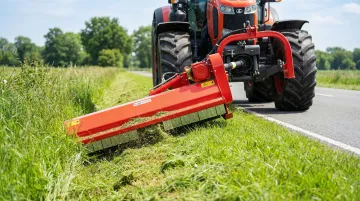
The enclosed housing traps cut material inside the deck during operation, significantly reducing the risk of stones, branches, or debris being ejected at high speed. This makes flail mowers the preferred choice near roads, public spaces, livestock, and structures.
A study of U.S. emergency departments estimated that 934,394 general lawn mower injuries were treated from 2005 to 2015, averaging 84,944 annually — many caused by projectile objects striking operators or bystanders.
The FDOT notes that flail mowers "discharge debris downward, reducing the danger from flying projectiles. For these reasons, flail mowers may be used in urban as well as rural areas."
Superior Mulching Output
The repeated cutting action inside the housing produces finer clippings than rotary alternatives, which decompose faster when returned to the soil — improving ground nutrition and leaving a cleaner visual finish without windrows (clumped rows of clippings).
Terrain Adaptability and Machine Durability
The swinging flail design absorbs impact from rocks and uneven ground without blade damage, making these machines well-suited for rough agricultural land and sloped areas where fixed-blade mowers would sustain frequent damage.
At a glance, flail mowers offer:
- Debris containment — housing directs cut material downward, not outward
- Finer mulch — repeated cutting produces clippings that break down quickly
- Impact resistance — swinging flails flex on contact rather than snapping
Flail Mower vs. Other Mowing Equipment
Flail Mower vs. Rotary Mower
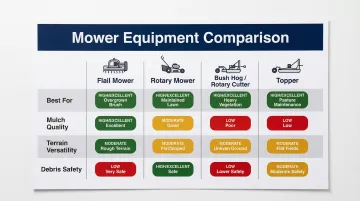
Rotary mowers use one or more rigid spinning blades and are best suited for flat, well-maintained lawns. Flail mowers are purpose-built for rough terrain, thick vegetation, and situations where debris projection is a safety concern — they keep displaced material contained rather than ejecting it outward. The tradeoff: flail mowers produce finer, more even mulch but typically run at lower forward speeds than rotary models.
Flail Mower vs. Bush Hog (Rotary Cutter)
A bush hog uses large, heavy, free-swinging blades to knock down and shred coarse vegetation very quickly and is valued for raw clearing power on heavily overgrown land. A flail mower trades some of that raw speed for better cutting height control, safer debris containment, and a cleaner mulch finish. If you're clearing a brushy field in one pass, a bush hog wins. If you need a consistent, manageable result afterward, the flail mower earns its place.
Note: "Bush Hog" is a registered trademark owned by Bush Hog, Inc., though the term is frequently used generically in U.S. agricultural usage to describe any heavy-duty rotary cutter.
Flail Mower vs. Topper
A topper is designed only to cut the tops off tall weeds and grass, leaving a coarse, large mulch, and does not handle rough or uneven terrain well. A flail mower cuts closer to the ground, produces a much finer mulch, and is far more versatile across terrain types and vegetation densities.
Flail Mower vs. Topper
A topper is designed only to trim the tops off tall weeds and grass — it leaves coarse, large clippings and struggles on uneven ground. A flail mower cuts much closer to the surface, produces finer mulch, and handles varied terrain that would stop a topper in its tracks.
Quick Comparison: Flail Mower vs. Common Alternatives
| Equipment | Best For | Mulch Quality | Terrain Versatility | Debris Safety |
|---|---|---|---|---|
| Flail Mower | Rough terrain, thick vegetation | Fine, even | High | Excellent |
| Rotary Mower | Flat, maintained lawns | Moderate | Low | Moderate |
| Bush Hog / Rotary Cutter | Heavy clearing, overgrown land | Coarse | Moderate | Low |
| Topper | Light topping of tall grass/weeds | Coarse | Low | Moderate |
Flail Mower Blade Types and Maintenance
Blade Shapes and Applications
Matching blade shape to your cutting task is the first step toward efficient operation. The three main types:
- Y-shaped (double-sided) flails — two cutting edges per blade for extended service life; ideal for grass, light weeds, and fine turf finishes with low machine strain
- T-shaped flails — general-purpose blades for grass and light brush; produce an excellent finish on hedges and mixed vegetation
- Hammer-type flails — heavy forged metal blocks built for woody vegetation, crop residue, tall weeds, saplings, and highway maintenance
Blade Wear Indicators
Operators should check regularly for:
- Rounded or chipped cutting edges
- Cracks near the mounting hole
- Significant weight loss from one side of the drum (which causes vibration)
- Uneven cut quality in the field
Replace affected flails immediately if they appear bent, deformed, cracked, or show cutting-edge gouges exceeding 1/2 inch — continued operation risks drum damage.
Blade Material Grade
Three hardness grades cover most operating conditions:
- Plain steel — high-carbon spring steel, heat-treated; cost-effective for standard grass and light vegetation work
- Hard-faced — wear-resistant overlay on the cutting edge; better suited to abrasive soils and heavier brush
- Super-Koat / coated — proprietary coating technology offering added protection against wear and corrosion in demanding conditions
For extreme rocky or abrasive terrain, tungsten carbide-reinforced flails provide excellent wear resistance, handling wood mulching, stone crushing, and stump grinding.
Dynamic Balancing and Replacement
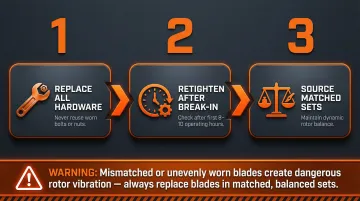
Because flail rotors spin at high speeds, blades must always be replaced in matched sets (or opposing pairs) to maintain dynamic balance. Operating with missing or mismatched blades causes severe vibration that will destroy the rotor bearings and the machine.
When swapping blades, follow these steps to protect the rotor and get maximum service life:
- Replace fastening hardware (bolts and nuts) along with the blades — never reuse worn hardware
- Retighten all blade hardware after the first 8–10 hours of operation
- Source matched-set replacements to keep the rotor in dynamic balance
Clean Cutter's replacement flail blades — available in plain, hard-faced, and Super-Koat grades — cross-reference major brands including Alamo, Rhino, Seppi, and Loftness, so finding a spec-correct replacement for most machines is quick.
Frequently Asked Questions
Why is it called a flail mower?
The name comes from the agricultural flail, a hand tool used to thresh grain by striking it. The mower replicates that motion: blades pivot outward from a rotating drum the same way a flail's striking head swings on its handle.
Which is better, a flail mower or a bush hog?
Neither is universally better. A bush hog excels at fast, aggressive clearing of heavily overgrown land, while a flail mower offers better cut quality, finer mulch, debris containment, and terrain control — making it the stronger choice where finish and safety matter.
What are flail mowers good for?
Flail mowers handle pasture maintenance, roadside and ditch bank clearing, crop residue management, brushy overgrowth, and hedge trimming. Their debris containment and mulching capability make them the right tool wherever cut quality and operator safety are priorities.
What is the difference between a flail mower and a rotary mower?
A rotary mower uses rigid spinning blades ideal for flat, maintained lawns, while a flail mower uses multiple swinging blades on a horizontal drum that are safer on rough terrain, handle tougher vegetation, and produce a finer mulch. The two tools rarely compete for the same job.
How often should flail mower blades be replaced?
Replacement frequency depends on vegetation type, soil abrasiveness, and blade grade. Inspect blades after every significant use for wear, chipping, or cracking, and always replace them in full sets to maintain drum balance.