
Introduction
From roadside clearing and pasture maintenance to municipal parks and agricultural land management, flail mowers handle vegetation jobs that most other cutters can't. Their enclosed cutting system and ability to mulch rather than throw debris make them a staple across commercial and agricultural operations.
Despite that widespread use, many operators and equipment buyers misunderstand how flail mowers actually work—and how they differ from rotary cutters or finishing mowers. That misunderstanding leads directly to wrong equipment choices, wasted money, and cut quality that falls short of what the job demands.
This guide breaks down what a flail mower is, how it works mechanically, what it's used for, and how it compares to other mower types—in plain, operational language.
Key Takeaways
- Rotating horizontal drum + freely swinging blades (flails) = precise cutting, shredding, and mulching in one pass
- Designed for heavy-duty tasks standard rotary or lawn mowers cannot handle—overgrown brush, roadside clearing, rough terrain
- Blades swing free on impact instead of snapping — safer around people, vehicles, and property than fixed-blade mowers
- Available as walk-behind models for smaller areas and PTO tractor-mounted versions for large-scale work
- Blade style (hammer, Y-blade, mulcher) and hardness grade directly affect how long blades last and what vegetation they can handle
What Is a Flail Mower?
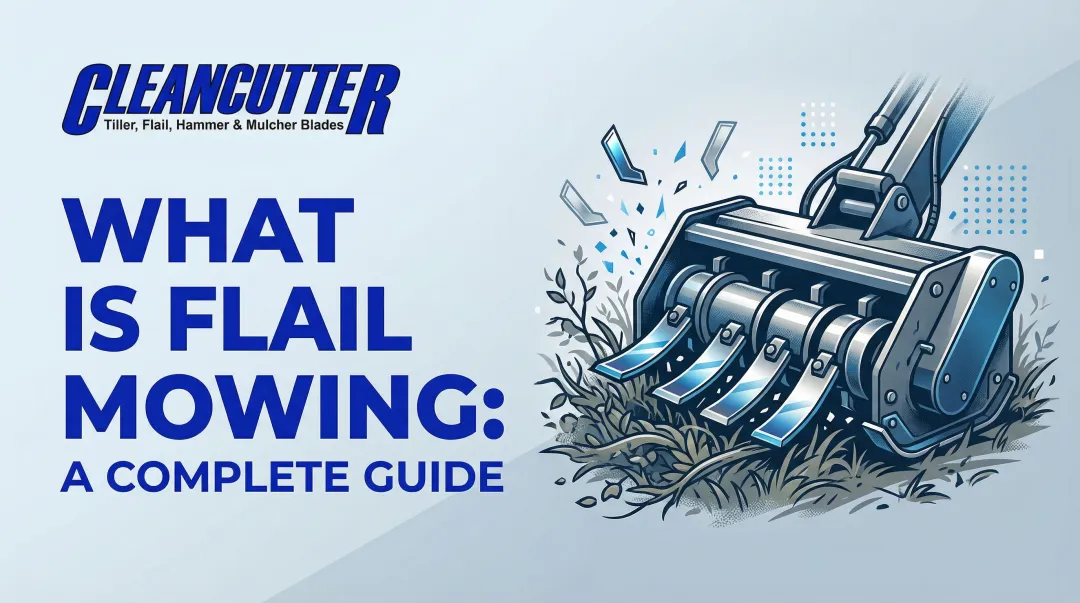
A flail mower is a powered agricultural and grounds maintenance machine that cuts vegetation using multiple small blades—called flails—mounted on a horizontal rotating drum. Unlike standard rotary mowers that use one or more large blades spinning on a vertical axis, flail mowers employ dozens of small, hinged cutting elements that swing freely at high speed.
Flail mowers were developed to handle dense, overgrown, or rough terrain vegetation that conventional spinning-blade mowers cannot safely or effectively manage. They fill the gap between a lawn mower and a full mulcher, offering controlled cutting power with superior debris containment.
That said, it's easy to confuse flail mowers with similar-looking equipment. Here's how they differ:
- Finishing mowers are built for manicured lawns, producing a golf-course-quality cut on maintained turf — not rough terrain
- Brush hogs (rotary cutters) use a single heavy blade on a vertical axis to aggressively knock down thick material
- Disc mowers use rotating discs optimized for forage and hay crop harvesting, not general vegetation management
The defining difference is the cutting mechanism: many small swinging blades on a horizontal drum, versus a single fixed blade on a vertical axis.
Flail Blade Types: T-Blade vs. Y-Blade
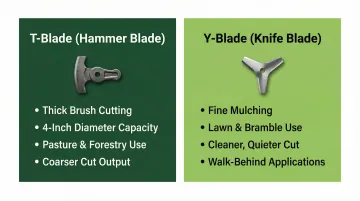
The two most common flail shapes serve distinctly different purposes:
T-Blade (Hammer Blade):
- Drop-forged from heavy-duty steel for maximum impact resistance
- Designed for cutting through thick shrubs, brush, and woody stems up to 4 inches in diameter
- Ideal for pasture management, land clearing, and forestry applications
- Produces a coarser, more aggressive cut
Y-Blade (Knife Blade):
- Lighter construction with a sharper edge optimized for fine cutting
- Best suited for heavy mulching tasks on lawn areas, brambles, and fine vegetation
- Produces a cleaner, finer cut with quieter operation
- Commonly used on walk-behind units and turf-oriented applications
Blade selection goes beyond vegetation type — grade matters just as much. Flails come in plain steel, hard-faced (welded for added abrasion resistance), and coated options. Clean Cutter's Super-Koat technology extends blade life on demanding jobs where rocks and abrasive debris accelerate wear, reducing how often you need to replace them.
Types of Flail Mowers
Flail mowers come in two main configurations based on power source and operational scale:
Walk-Behind Flail Mowers:
- Self-powered with onboard engines (typically Honda gas engines)
- Cutting widths range from 25.6 to 31.5 inches
- Suitable for small to medium areas with restricted access
- Ideal for steep slopes (up to 20 degrees), tight urban spaces, and shorelines
- Track-driven models provide superior traction on challenging terrain
PTO-Driven Tractor-Mounted Flail Mowers:
- Powered by a tractor's Power Take-Off (PTO) shaft
- Cutting widths range from 59 inches to 327 inches for multi-gang setups
- Used for large-scale agricultural, forestry, and roadside applications
- Require matching tractor horsepower to mower size (typically 25-162+ HP)
How Does a Flail Mower Work?
A flail mower operates through a defined mechanical sequence: power input spins the drum, centrifugal force extends the flails, and the swinging action cuts and shreds vegetation on contact. Each stage contributes to the machine's safety profile and output quality.
How the Machine Is Powered
PTO-driven models receive rotational energy from a tractor's power take-off shaft, which is redirected through a right-angle gearbox to spin the horizontal drum. Walk-behind models use an independent engine to drive the drum directly.
The drum typically spins at high RPM (between 1,800 and 3,000 RPM depending on the model), and the PTO driveshaft connection must match the tractor's RPM output: either 540 RPM or 1000 RPM. Running a mower below its rated RPM reduces rotor speed and causes uneven, incomplete cuts.
The gearbox unit is typically equipped with an internal freewheel (overrunning clutch) that absorbs the rotor's massive inertia during stopping, preventing the mower's momentum from driving the tractor forward or causing transmission damage when the PTO is disengaged. That inertia management is what makes the drum's high-speed rotation practical in field conditions.
The Rotating Drum and Flail Cutting Action
As the drum rotates at speed, centrifugal force pushes the flails outward into a rigid cutting position. When a flail contacts vegetation, it shreds and cuts it rather than making a single clean slice like a rotary blade.
This pivot design also delivers a meaningful safety advantage. If a flail strikes a rock or immovable object, it swings back on its pivot point (chain link or bracket) rather than deflecting the object outward. Fixed-blade rotary mowers can launch projectiles at high velocity — up to 300 feet under adverse conditions — while flail mowers contain debris within the enclosed housing.
Flails are mounted in staggered rows across the drum to ensure a continuous, even cut across the full cutting width, reducing uncut strips and wear unevenness.
Output: Mulching and Finished Cut
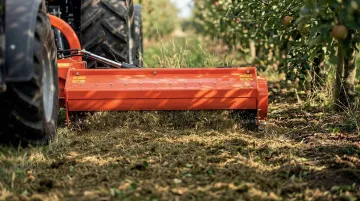
Cut vegetation is contained within the mower's enclosed housing and re-cut repeatedly by successive flails before being deposited back onto the ground as fine mulch. Unlike rotary mowers that discharge clippings to one side, flail mowers discharge material downward within the chamber.
Finely shredded clippings decompose quickly and return organic matter and nutrients to the soil. Research shows that smaller residue fragments accelerate microbial breakdown, making flail mowers a preferred choice for pasture and orchard floor management where nutrient cycling matters.
What Is a Flail Mower Used For?
Flail mowers serve multiple professional applications where cutting power, debris containment, and terrain adaptability are required:
Agricultural Settings:
- Clearing overgrown pasture and managing paddocks
- Mulching orchard floors and vineyard cover crops
- Processing crop residue after harvest
- Maintaining fields with uneven, debris-strewn ground without machine damage
Roadside and Municipal Maintenance:
- Prevent debris projection near traffic and pedestrians — the enclosed cutting system makes flail mowers the preferred choice for highway departments and municipalities
- FDOT and FHWA guidelines specifically recommend flail mowers for roadside and urban right-of-way maintenance to minimize liability
- Handle slopes and ditches common to roadside terrain
Landscaping and Grounds Maintenance:
- Estate management and public park clearing
- Golf course rough areas and sports field perimeters
- Situations requiring both a clean mulched finish and operational safety
Forestry and Heavy Vegetation Clearing:
- Robust flail mower variants (flail mulchers or flail shredders) clear brush, saplings, and heavy scrub
- Can be positioned to trim the sides of hedges and embankments—something rotary mowers cannot do
Key Benefits of Using a Flail Mower
Safety
The swinging-flail design greatly reduces debris throw compared to fixed-blade mowers. Because flails fold away when striking hard obstructions and the housing discharges debris downward, flail mowers are the preferred choice for work near roads, structures, livestock, or populated areas.
Mulching and Soil Health
The fine, even mulch produced by repeated flail-cut action reduces the need for debris removal and supports natural soil nutrient cycling. Studies confirm that mowing cover crops into smaller pieces accelerates decomposition compared to leaving larger clippings—a time and cost benefit for farm and land managers.
Durability and Low Maintenance Cost
Because each flail blade is individually mounted, damaged blades can be replaced one at a time rather than requiring full drum or deck replacement.
Real-world cost comparison:
| Component Type | Brand/Model | Price Range |
|---|---|---|
| Individual Flail Hammer Blade | Land Pride 891-501C | ~$25 |
| Individual Flail Y-Blade | Land Pride 891-469C | ~$19 |
| Rotary Cutter Blade | Bush Hog 91198/91197 | $59–$80 |
| Rotary Cutter Blade | Servis-Rhino 681063 | ~$68 |
At $19–$25 per blade versus $59–$80 for comparable rotary blades, the per-strike replacement cost is two to four times lower — a meaningful difference for operations that regularly work rocky or debris-heavy ground.
Flail Mower vs. Rotary Mower: Key Differences
The mechanical design of each mower type determines where it works — and where it fails. Here's how the three most common heavy-duty mowers stack up:
| Rotary Mower | Flail Mower | Brush Hog | |
|---|---|---|---|
| Cut action | Fixed blade slices | Swinging flails shred | Heavy blade knocks down |
| Debris throw risk | High | Low | High |
| Best terrain | Flat, maintained lawns | Rough fields, roadsides, slopes | Open land, heavy brush |
| Finish quality | Clean, manicured | Fine mulch, even spread | Coarse, uneven |
| Blade damage | Full-blade replacement | Individual flail replacement | Full-blade replacement |
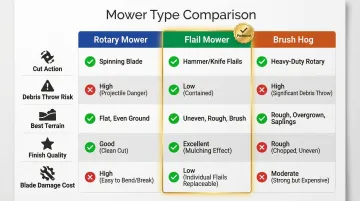
Rotary mowers are the right tool for maintained grass on open, clean ground. The fixed blade delivers a clean cut when debris isn't a concern — but strike a rock or hidden object, and the blade takes the full impact.
Flail mowers trade the clean cut for durability and safety. The swinging flails pivot back on impact rather than absorbing the force directly, which protects the hardware and keeps debris contained close to the ground. That matters on roadsides, near fencing, or anywhere bystanders could be in range.
Brush hogs occupy a different category. They're built for speed and volume — knocking down dense stands of brush quickly in open, unpopulated areas where finish quality is irrelevant. What they don't do is mulch. Material gets flattened rather than shredded, and the debris throw risk is comparable to a rotary mower.
For most agricultural and roadside applications, the flail mower's combination of debris containment, fine mulch output, and blade-level replaceability makes it the more practical long-term choice.
Conclusion
A flail mower's design—centrifugal flail action, enclosed housing, and individually mounted blades—makes it better suited for heavy vegetation and rough terrain than most other mower types. The blades swing free on impact instead of shearing off, which is what keeps per-hour maintenance costs lower than comparable fixed-blade machines.
Understanding what a flail mower does and how its blades perform under load helps operators select the right blade type and grade for their terrain. Maintenance managers can plan timely blade replacement based on actual wear patterns rather than catastrophic failures.
Clean Cutter has been manufacturing compatible replacement flail blades since 1963. The catalog covers three blade grades to match the job:
- Plain — standard-duty cutting for routine mowing conditions
- Hard-Faced — extended wear resistance for abrasive or rocky terrain
- Super-Koat — proprietary coating for maximum blade life in high-impact applications
Whether you're running Alamo-Mott, Rhino, or another major brand, matching the blade grade to your actual field conditions is the single fastest way to cut replacement frequency and keep the mower earning its hours.
Frequently Asked Questions
What is a flail mower used for?
Flail mowers are used for cutting overgrown grass and brush, roadside and ditch maintenance, pasture clearing, orchard floors, and municipal grounds management where debris containment and rough terrain capability are required. They are the preferred choice when debris projection near roads, structures, or people is a concern.
Can you mow your lawn with a flail mower?
While technically possible on established lawns, flail mowers are not designed for fine finishing cuts. They are better suited to rough or overgrown areas. A standard lawn mower or finishing mower will produce a cleaner result on maintained turf.
How much HP do you need to run a flail mower?
HP requirements vary by mower size and cutting width. Smaller units (60-72 inches) require 25-30 HP minimum, while heavy-duty commercial units (300+ inches) require 150-162+ HP. Check the manufacturer's spec sheet to confirm your tractor's PTO output meets the mower's requirements.
Can you mow in reverse with a flail mower?
Most manufacturer manuals explicitly warn against it. Some models can cut in reverse at reduced speed, but it is less efficient and carries safety risks. Standard practice is to disengage the PTO, raise the mower, reposition, and cut moving forward.
How big of a tree can a flail mower cut?
Standard flail mowers handle grass, weeds, and light brush up to 1-1.5 inches in diameter. Heavy-duty flail mulchers with forged hammer blades can process thick vegetation and saplings up to 3-4 inches in diameter.
What's better: a brush hog or a flail mower?
A brush hog is better for knocking down heavy, thick material quickly where finish quality is unimportant. A flail mower is the stronger choice where debris safety, mulching quality, or proximity to roads and people matters.