Introduction
Forestry mulcher blades are the direct point of contact between the machine and everything from dense brush to hardwood trees. They spin at high velocity to cut, shred, or grind vegetation into on-site mulch—and the type you run determines far more than most operators expect.
The wrong blade choice has real consequences: accelerated wear, reduced clearing speed, and poor mulch quality. In rocky terrain, fixed steel blades can cause bent rotor shafts, missing balance weights, and bearing destruction. In clean hardwood stands, swing blades may give up cutting aggression without offering protection you actually need.
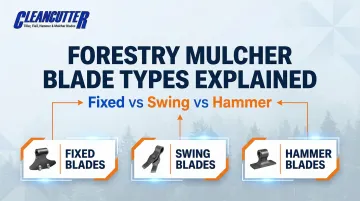
Here's how fixed, swing, and hammer blades each work, where they hold up, and how to match the right type to your job conditions.
Key Takeaways
- Forestry mulchers use three blade types: fixed (bolted solid), swing (pivot on impact), and hammer (impact-driven grinders)
- Fixed blades deliver maximum cutting speed in clean terrain with low rock or debris risk
- Swing blades flex back on impact, protecting the rotor and drivetrain in rocky or debris-heavy terrain
- Hammer blades grind through impact force, excelling at shredding stumps and dense brush into fine mulch
- Right blade selection depends on terrain, vegetation type, desired mulch finish, and machine horsepower
What Are Forestry Mulcher Blades?
Forestry mulcher blades are the cutting tools mounted on the rotating drum or rotor of a forestry mulcher attachment or machine. The industry uses the terms "blades," "tools," and "teeth" interchangeably depending on the manufacturer—Fecon refers to "tools" and "knives," FAE uses "teeth" and "hammers," while Loftness specifies "knives" and "blades".
These blades function by spinning at high velocity to cut, shred, or grind vegetation—trees, brush, stumps, and roots—into mulch that is left on site. This article focuses on drum/rotor-based systems, which work differently from disc mulchers in both cutting mechanism and output quality.
Drum vs. Disc Mulchers: Understanding the Difference
| Feature | Drum Mulcher | Disc Mulcher |
|---|---|---|
| Cutting Mechanism | Cylindrical drum with continuous downward grinding motion | Large spinning disc with centrifugal force |
| Mulch Quality | Fine and uniform | Coarse and scattered |
| Ground Contact | Closer to ground; better for stump grinding | Limited contact; mostly above-ground |
| Debris Field | Safer discharge; pushes material toward the ground | Throws mulch farther; rougher finish |
Drum mulchers dominate land-clearing applications precisely because of how their blades interact with material. Understanding the blade types mounted on that drum — fixed, swing, and hammer — is where selection decisions get specific.
Why Blade Type Matters in Forestry Mulching
Blade type affects far more than cutting speed. Get it wrong and you're looking at consequences across machine protection, mulch particle size, rotor balance, replacement frequency, and total operating cost:
What Goes Wrong:
- Fixed blades in rocky conditions: Rotor damage, mount cracking, bent shafts, and bearing failure that far exceeds blade replacement costs
- Swing blades in dense hardwood: Blades deflect instead of bite, dropping throughput and forcing multiple passes on material that fixed tooling would clear in one
- Hammer blades in light brush: Engine load climbs with no productivity return — you're burning fuel to power tooling that's overkill for the material
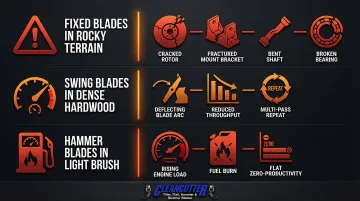
Matching blade type to your actual operating conditions is where machine longevity and job profitability are decided.
The Three Types of Forestry Mulcher Blades
Forestry mulcher blade selection is not one-size-fits-all. The right type depends on terrain conditions, vegetation density, desired mulch finish, carrier machine power, and how much rocky debris is present in the work area.
Fixed Blades
Fixed blades (also called fixed knives or fixed tools) are rigidly bolted to the rotor drum with no pivot point. They do not move independently when they strike material — the rotor's rotational energy drives the blade straight through whatever it contacts. Because they transfer 100% of impact energy directly into the cutting edge, they deliver superior cutting aggression. The trade-off: no mechanical relief if they hit a buried rock or hard obstacle.
Best Suited For:
- Cleared land with minimal rock content
- Pasture reclamation and brush clearing
- Vegetation management on known terrain
- Operators who work on consistent soil conditions without hidden debris
Key Strengths:
- Deliver the cleanest, most aggressive cut per pass
- Produce uniform mulch finish
- Maintain consistent cutting geometry over their service life
- Generally simpler to replace and easier to sharpen or rotate
- Highest productivity and best finish in soft soil applications
Limitations/Trade-offs:
Because there is no swing mechanism, a single hard rock strike can crack or deform the blade mount, damage the rotor, or cause vibration imbalance. OEM manuals explicitly warn that blade life is reduced if operated in rocky terrain, and that striking rocks causes bent shafts and rotor deformity. In mixed-terrain applications or land with embedded rocks, fixed blades significantly increase the risk of costly rotor damage.
Swing Blades
Swing blades (also called swing hammers or flail blades) mount on hinge pins that let them pivot backward on hard contact. Under normal operation, centrifugal force holds them extended for cutting. On a rock strike, they fold back instead of absorbing the full impact, then swing back into position — protecting the rotor body and carrier machine drivetrain from damage. That pivot mechanism is what separates them from fixed blade designs.
Best Suited For:
- Mixed terrain with occasional rocks, roots, or buried debris
- Land clearing in unknown or varied ground conditions
- Operations where protecting the machine from unforeseen impacts is a priority
- Professional land clearing and vegetation management on varied terrain
Key Strengths:
- Sharply reduce the risk of rotor damage on rock strikes
- Extend equipment service life in rough conditions
- Allow operators to work more aggressively in terrain where they cannot fully verify subsurface conditions
- Specifically designed for applications with high rock presence
Limitations/Trade-offs:
The swing mechanism introduces more moving parts (pins and pockets) that require regular inspection and lubrication. The normal greasing interval of eight hours may not be enough in severe conditions. Swing blades can generate slightly less cutting aggression per pass compared to fixed blades because some energy is absorbed by the pivot action. Worn pins or loose pockets can cause rotor imbalance.
Hammer Blades
Hammer blades (also called hammer tools or hammer knives) use a thicker, more blunt profile to pulverize and grind material through impact force rather than a slicing cut. Manufacturers build them wider and heavier than swing or fixed blades, engineering them to break down wood fiber through repeated high-velocity blows. Where fixed and swing blades cut, hammer blades grind — reducing woody material to fine particles through impact energy. Many designs also incorporate a pivot mechanism, combining grinding capability with rock protection.
Best Suited For:
- Processing stumps and dense hardwood brush
- Heavy slash piles requiring fine particle reduction
- Material that needs a fine, consistent mulch finish
- Habitat restoration, right-of-way maintenance, and pipeline corridor clearing where mulch quality matters
Key Strengths:
- Produce the finest, most consistent mulch particle size
- Excel at breaking down woody material and stumps
- Highest wear resistance in rocky environments
- Combine grinding capability with impact protection when designed with pivot mechanisms
Limitations/Trade-offs:
Hammer blades typically require more horsepower to drive effectively because the grinding action creates greater resistance than a slice cut. Large excavator hammer heads require 40-150 GPM hydraulic flow, while tractor-mounted hammer rotors require 160-240 HP. They may wear faster than carbide-tipped alternatives in abrasive sandy or rocky soils, and productivity (acres per hour) may be lower compared to fixed blades in lighter vegetation.
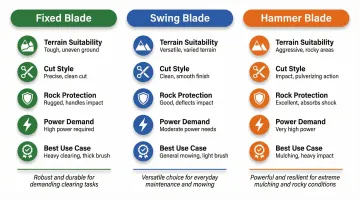
Here's how the three blade types compare at a glance:
| Blade Type | Terrain | Cut Style | Rock Protection | Power Demand | Best Use Case |
|---|---|---|---|---|---|
| Fixed | Soft, rock-free | Slicing/chipping | None | Lower | Pasture clearing, brush |
| Swing | Mixed, varied | Slicing with relief | High | Moderate | Unknown terrain, land clearing |
| Hammer | Any, rocky | Grinding/impact | High (with pivot) | High | Stumps, fine mulch, corridors |
How to Choose the Right Forestry Mulcher Blade Type
The "right" blade is the one that matches the specific combination of terrain, vegetation type, machine capability, and acceptable risk—not simply the most popular option or the one that came with the machine.
Terrain and Obstacle Risk
The single most important factor is whether rocks, stumps, or buried debris are present. Rocky or uncertain terrain should default to swing or hammer designs for machine protection, while known clean terrain can use fixed blades for maximum efficiency.
Vegetation Type and Density
The type and size of material being processed affects blade selection significantly:
Cutting Capacity by Machine Class:
| Machine Class | Max Cutting Diameter | Optimal Tool Type |
|---|---|---|
| Compact/Skid Steer (40-135 HP) | 5 to 8 inches | Fixed Knives / Carbide |
| Mid-Size/Excavator (10-20 Ton) | 8 to 12 inches | Fixed Carbide / Swing Hammers |
| Large Forestry Tractor (300-600 HP) | 16 to 24 inches | Heavy-Duty Fixed Hammers |
Machine class sets the ceiling on what you can cut. Within that ceiling, material type drives blade choice: light brush and grass favor fixed or swing blades for speed, while heavy hardwood or stumps favor hammer blades for grinding capability.
Desired Mulch Finish
If the end result needs to be fine, even mulch (for erosion control or site cleanup, for example), blade type matters. Fixed steel knives slice cleanly, producing a consistent chip size. Hammer blades grind through impact, typically producing finer, more uniform particles from dense or fibrous material. Projects with specified mulch quality requirements should factor this into blade selection.
Blade Material and Coating Grade
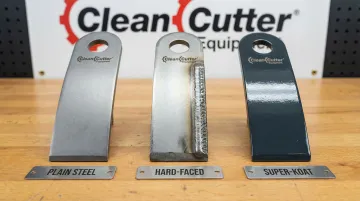
Beyond blade type, operators should consider the hardness grade of replacement blades. Options typically include:
- Plain steel: Lowest upfront cost but faster wear
- Hard-faced: Wear-resistant overlay for extended service
- Super-Koat coated: Premium protection for severe or abrasive conditions
Clean Cutter manufactures replacement flail blades in plain, hard-faced, and Super-Koat coated grades. The same grading logic applies when selecting any replacement cutting blade: matching hardness grade to your soil abrasiveness and cutting frequency directly affects how long a blade lasts between changes.
Machine Horsepower and Carrier Compatibility
Hammer blades require more hydraulic or mechanical power to run efficiently. Underpowered machines paired with hammer tools will experience excessive heat, reduced productivity, and accelerated drivetrain wear. Low-flow skid steers (15-35.9 GPM) require specific mulching heads, while high-flow heads demand 30-50 GPM and up to 6,000 PSI. Always match blade type to the carrier's rated horsepower and hydraulic flow specs before purchasing.
Common Mistakes to Avoid When Selecting Forestry Mulcher Blades
Using Fixed Blades in Rocky or Unknown Terrain
This is the most common and costly mistake. Operators who prioritize cutting aggression over machine protection often face rotor damage, mount failures, and expensive downtime that far exceeds the cost of switching to swing blades. Always assess terrain conditions before defaulting to fixed blade configurations.
Selecting Blade Type Based on Lowest Upfront Cost
Cheaper, plain-steel blades may have a lower purchase price but wear significantly faster in abrasive conditions, requiring more frequent replacement and more downtime. Carbide-tipped teeth last 60-150 hours depending on conditions, while hardened steel teeth wear faster, lasting 20-80 hours.
Hard-faced and coated options reduce replacement frequency and cut the cost per acre over time.
Ignoring Pin and Pocket Wear on Swing Blade Systems
Neglecting worn swing blade pins and mounting pockets causes rotor imbalance. That imbalance generates vibration, which accelerates bearing failure and rotor damage — repairs that routinely cost more than a full blade replacement would have.
If a knife is replaced, the knife on the opposite side of the rotor (180 degrees) must also be replaced to maintain balance. Inspect pins and pockets every time blades are changed — not just when something feels wrong.
Conclusion
Fixed, swing, and hammer blades each serve a distinct purpose in forestry mulching. Matching the blade type to terrain, vegetation, and mulch quality requirements is what separates efficient, low-maintenance operations from costly ones.
Blade selection is not a one-time decision. As terrain and project types shift between jobs, revisit three variables:
- Blade configuration — fixed, swing, or hammer based on vegetation density and ground conditions
- Material grade — plain steel for light work, hard-faced or coated options for rocky or abrasive terrain
- Replacement intervals — worn blades increase fuel draw and reduce cut quality faster than most operators expect
Keeping these factors aligned with actual field conditions is what extends equipment life and keeps operating costs predictable.
Frequently Asked Questions
What are the different types of mulcher teeth?
The three main types are fixed blades (rigidly bolted to the rotor), swing blades (pivot on hinge pins for impact protection), and hammer/flail tools (blunt grinding implements). Material grades—plain steel, hard-faced, and carbide-tipped—add a further dimension to selection based on wear conditions.
What are the best teeth for a forestry mulcher?
The right tooth depends on terrain, vegetation type, and machine power. Swing blades suit rocky ground where impact protection matters most; fixed blades excel at high-volume clean cutting; and hammer tools produce the finest mulch finish.
Do mulching blades work better than regular blades?
Mulching-optimized blades (like hammer tools) produce finer material but may sacrifice speed, while standard cutting blades clear faster in lighter vegetation. Steel planer teeth offer the best productivity and finish, while hammer teeth provide the highest wear resistance but lower productivity.
What size tree can a forestry mulcher cut?
Capacity varies by machine size and blade type. Skid-steer mounted drum mulchers typically process material up to 5 to 8 inches in diameter, mid-size excavator heads handle 8 to 12 inches, and large forestry tractors can process trees up to 24 inches in diameter.
How long does it take a forestry mulcher to clear 1 acre?
Clearing time depends on vegetation density, terrain, and blade selection. A USDA Forest Service study recorded 0.57 acres per hour on average, while skid steer mulchers in light brush can average around 0.375 acres per hour. Fixed steel teeth consistently deliver the highest acres-per-hour rates across blade types.