Introduction
OEM custom mower blades are precision wear parts for flail and tiller equipment—when specifications are off, the entire cutting system suffers. Many operators struggle with a common pain point: ordering generic replacements that don't match original geometry, leading to vibration, poor cut quality, and premature equipment wear. At high rotor speeds, even a 35-gram weight difference can generate over 22 kg of destructive centrifugal force, cutting bearing life by more than 30% and causing $500–$1,000 per day in downtime.
Getting the order right the first time prevents all of that. Here's exactly what to gather, what to check, and what to avoid when sourcing replacement blades for your equipment.
Key Takeaways
- OEM custom mower blades match your equipment's original geometry, mounting configuration, and material spec—not just generic "will-fit" parts
- Before contacting suppliers, have your blade part number, equipment model, and dimensions (length, width, thickness, hole pattern) ready
- Blade material grade and coating determine how long blades last and what you'll spend replacing them
- Lead times for custom orders vary—plan ahead and confirm minimum order quantities before peak season
- A cross-reference system or sample blade speeds up the process and reduces spec errors
What Are OEM Custom Mower Blades?
OEM (Original Equipment Manufacturer) blades are manufactured to match or exceed the original equipment maker's specifications in geometry, steel grade, and mounting configuration. Produced to exact factory standards, they deliver guaranteed compatibility, consistent steel quality, and warranty protection.
The "custom" distinction matters: custom OEM blades are built to a specific equipment's requirements rather than pulled from a standard retail shelf. This becomes critical when blades are discontinued, out of spec, or needed in non-standard configurations.
The global farm equipment aftermarket parts market is valued at $54.8 billion, with independent aftermarket options typically priced 20-45% lower than OEM equivalents. Those savings come with real risks — dimensional mismatches, inferior steel grades, and voided warranties are common failure points.
Flail mower blades vs. rotary deck blades:
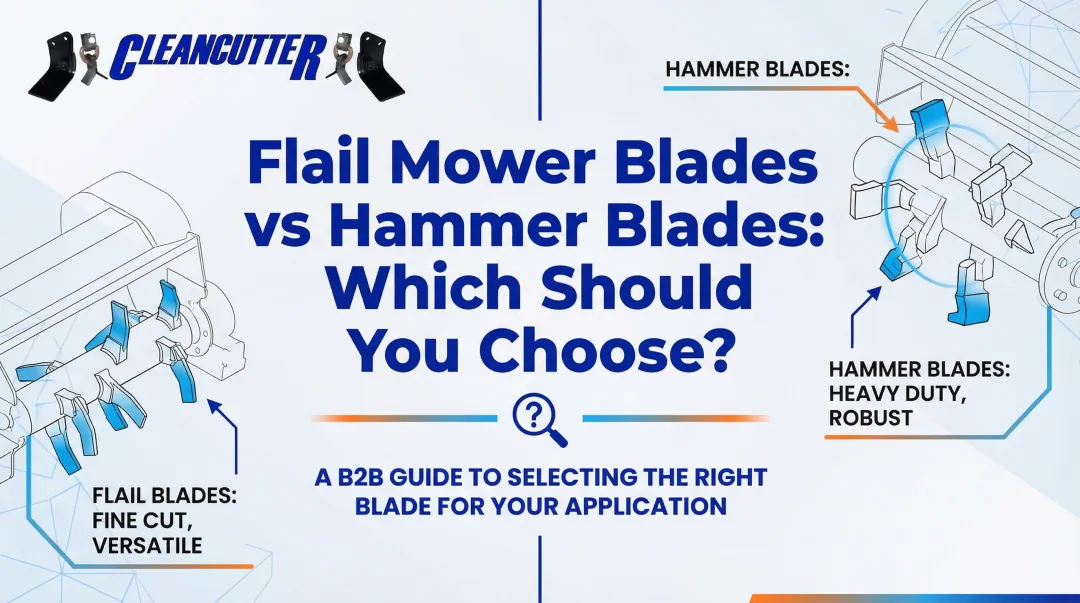
Flail mower blades — hammer or Y-blade designs mounted on a spinning rotor — involve significantly more ordering variables than rotary deck blades. Key specs that differ by manufacturer include:
- Rotor configuration and blade count
- Blade style (hammer vs. Y-blade vs. cup knife)
- Mounting pin diameter and hardware type
- Directional orientation (left- vs. right-hand)
Getting these wrong isn't just a compatibility issue — it's a safety risk. Precise specification is essential before placing any custom order.
How to Order OEM Custom Mower Blades: Step-by-Step
Step 1: Identify Your Equipment and Existing Blade Specs
Start by locating the part number stamped on your existing blade—typically found between the center mounting holes. Record your equipment make, model, and rotor/deck configuration from the owner's manual or manufacturer's parts catalog.
If the part number is unreadable or discontinued, capture these measurements:
- Overall length (measured diagonally tip-to-tip for rotary blades)
- Blade width at widest point
- Steel thickness
- Center hole type and diameter (or pin bore for flail blades)
- Mounting hole spacing (center-to-center distance)
- Outer hole diameter where applicable
- Blade style (Y-blade, hammer blade, offset blade)
- Left-hand and right-hand orientation if your rotor requires matched pairs
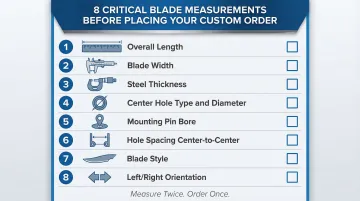
Flail rotors often require directional blades installed in matched pairs — an easy detail to overlook that causes balance problems during operation.
Step 2: Choose Your Blade Material Grade and Coating
Understand the primary blade grade options:
- Plain steel – Standard wear resistance; suited to moderate field conditions
- Hard-faced – Welded carbide overlay for rocky, abrasive terrain
- Proprietary coated grades – Advanced surface treatments that resist corrosion and reduce friction
- Combination options – Some suppliers offer hard-faced blades with a secondary coating for dual-layer protection
Match grade to operating conditions. Rocky or debris-heavy terrain demands higher hardness and wear resistance, while softer agricultural fields may not require premium grades, allowing cost savings.
Check the parts manual or contact your equipment manufacturer directly to confirm what coating or hardness grade your original OEM blade used. For example, Clean Cutter's Super-Koat coating is a proprietary surface treatment engineered to extend blade service life in demanding conditions.
Field tests of laser-clad and carbide-reinforced blades show continuous operation past 76–120 hours with minimal edge degradation — extending service life by 2.5x to over 3x compared to untreated steel.
Step 3: Contact Your Supplier and Submit Order Details
Provide your supplier with complete information:
- Part number or full measurement set
- Equipment model and manufacturer
- Blade style and orientation (left/right if applicable)
- Preferred material grade and coating
- Required quantity
Key questions to ask your supplier:
- What is the minimum order quantity (MOQ)?
- What is the estimated lead time?
- Is a sample blade submission needed to verify fit before full production?
- How are blades packaged—in sets matched to rotor count?
Clarify packaging requirements to ensure balanced installation from the start.
Step 4: Verify the Order Upon Receipt
Once your order arrives, don't head straight to the field. Physically compare received blades against your worn original before installation:
- Check length, thickness, and center hole configuration
- Verify mounting pin bore dimensions
- Inspect coating integrity and finish quality
Chips, inconsistencies, or uneven hardface application can indicate quality issues that may shorten blade life or cause balance problems.
Test-fit one blade on the rotor before committing to full installation. Confirm free movement, correct pin engagement, and no contact interference with the housing or deflector.
What You Need Before Placing Your Order
Wrong or mismatched blades almost always trace back to incomplete specs at the time of ordering. Getting the right information together upfront takes less time than managing a return.
Equipment Documentation
Gather the OEM parts manual or parts catalog for your mower model. If unavailable, check the manufacturer's website or contact their parts department to obtain the original blade part number and spec sheet. As the average age of agricultural machinery exceeds 12–14 years, OEMs frequently discontinue specific part numbers, making accurate documentation essential.
The Existing Blade as a Reference
Whenever possible, have the worn blade physically on hand. It serves as the most reliable reference for dimensions, hole configuration, and blade style. Many suppliers can use it directly for cross-referencing or pattern matching.
Key Measurements to Capture
Record these critical dimensions:
- Overall blade length
- Blade width at widest point
- Steel thickness
- Center hole type and diameter (or pin bore for flail blades)
- Outer hole center-to-center spacing where applicable
Quantity and Rotor Configuration
Determine how many blades are required per rotor, how many rotors or machines need servicing, and whether blades must be ordered in matched sets for balanced installation. This also helps establish whether your order volume qualifies for volume pricing.
Timeline and Budget
Custom blade production typically runs anywhere from a few days to several weeks, depending on grade and quantity. Check supplier lead times before scheduling maintenance downtime — ordering well ahead of peak season prevents equipment from sitting idle while you wait.
Key Parameters That Affect Your Custom Blade Order
Even with the right part number, outcomes vary. Blade geometry, material spec, coating quality, and balance all determine how long a blade lasts and how well it performs under load.
Blade Geometry and Dimensional Accuracy
Blade length, thickness, and hole placement determine whether the blade fits safely, spins without vibration, and cuts at the correct height. Even a few millimeters of deviation can cause rotor imbalance—and the consequences scale fast.
At 2,000 RPM, a 35-gram offset at 15 cm radius generates over 22 kg of centrifugal force, cycling 33 times per second. That imbalance accelerates bearing wear and can cause wallowed-out bearing housings — a repair running $200–$500 per housing.
Steel Grade and Rockwell Hardness
Harder steel resists abrasion longer but gets brittle under impact — a real problem on rocky terrain. Softer grades absorb shock better but wear faster in abrasive soils.
Boron steels (such as 10B38) heat-treated to 48–55 HRC hit the practical sweet spot: enough wear resistance to pass ASAE S474 impact tests (the industry standard for blade impact resistance) while retaining toughness. Pushing hardness above 60 HRC without a ductile core leads to brittle fracture when blades strike field debris.
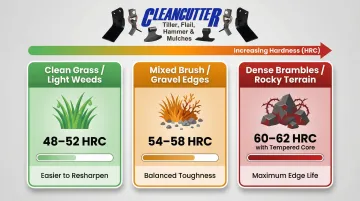
Recommended hardness by condition:
- Clean grass, light weeds: 48–52 HRC (easier to resharpen, higher wear in abrasive soil)
- Mixed brush, gravel edges: 54–58 HRC (balanced toughness and edge retention)
- Dense brambles, rocky terrain: 60–62 HRC with tempered core (surface hardness maximizes edge life while core absorbs shock)
Coating and Surface Treatment
Coatings reduce corrosion, lower cutting friction, and slow edge wear — all of which matter most for flail blades running in wet or high-debris conditions.
Laser cladding with 17-4PH-30%TiC composite showed a 67% reduction in wear mass loss compared to uncoated blades. After 120 hours of field testing, laser-clad blades remained functional while standard commercial blades had completely failed. Clean Cutter's Super-Koat treatment applies a similar hardened surface layer, extending blade service life in the abrasive soil and high-debris conditions where plain blades fail fastest.