Rotary tiller blades have a sharpening "window." Sharpen too early, and you're removing material that still has life left. Wait too long, and the blade is already damaged beyond saving. Use the wrong grinding technique, and you can remove the blade's temper, thin critical stress points, or ruin hard-faced overlays designed to self-sharpen.
This guide covers how to read the signs that sharpening is actually needed, the correct technique that preserves blade integrity, and the conditions where replacement beats sharpening every time.
Key Takeaways
- Dull blades show up as poor soil penetration, engine strain, and clumpy results
- Sharpen before the season and after heavy use in rocky or compacted soil—not on a calendar schedule
- Use an angle grinder or file and maintain the original bevel angle; never grind deep gouges
- Hard-faced blades self-sharpen through differential wear; grinding them destroys that built-in advantage
- Bent, cracked, or heavily rusted blades should be replaced, not sharpened
Why Blade Sharpness Directly Affects Your Tiller's Performance
Sharp blades slice through soil cleanly. Dull blades push, drag, and batter it — fundamentally changing the physics of tillage. That shift from efficient shearing to impact-crushing hits you in three places:
- Engine load increases as soil-tool friction climbs
- Fuel consumption rises to maintain 540 RPM PTO speed
- Drive components wear faster under the added stress
Research shows that optimized blade geometry and sharpness can reduce tillage resistance by up to 12%, which translates directly to lower PTO torque requirements. Once blades dull, soil-tool friction climbs exponentially. A rounded edge isn't cutting anymore — it's hammering soil apart through brute force.
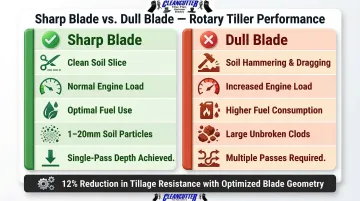
Soil quality takes the hit too. Dull blades produce large, unbroken clods instead of the ideal 1–20mm particle size needed for proper seedbed preparation. That clumpy result fails to break up compaction, leaves crop residue unincorporated, and creates poor seed-to-soil contact — all of which hurt germination and crop establishment.
The mechanical toll compounds over time. Dull, over-stressed blades are more prone to cracking or bending under load as metal fatigue accumulates. Increased draft also triggers continuous slip clutch activation, leading to friction disk glazing and gearbox overheating.
Unbalanced or severely worn blades add another problem: excessive vibration that can damage gearbox bearings and crack the tiller housing itself.
How to Tell When Your Rotary Tiller Blades Actually Need Sharpening
There is no universal hour-based sharpening interval. The need for sharpening depends heavily on soil type, frequency of use, and whether you've run through debris or hard obstructions. Instead of following a fixed calendar, inspect blades based on performance signals and physical condition.
Visual and Physical Indicators
A dull blade has a distinct appearance up close:
- Rounded or chipped leading edge instead of a defined cutting angle
- Visible nicks and scoring along the blade surface
- Shiny flat edge rather than a crisp bevel
- Visible wear patterns that show the blade has lost its original profile
With the machine OFF and spark plug wire disconnected, run a gloved finger across the blade edge. A sharp blade has a consistent, defined bevel you can feel clearly. A dull one feels flat or ragged.
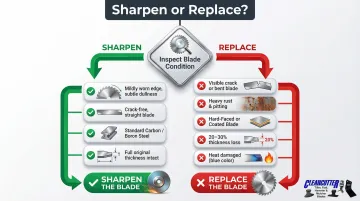
OEM manufacturers mandate replacement when blades have lost 20–30% of their original thickness or have only 1/4 inch of the tip remaining. Keep a new blade in your shop as a reference—when your working blades fall short of that profile, replace them.
Performance-Based Signals
Your tiller will tell you when blades need attention:
- Tiller bouncing or skipping rather than digging smoothly
- Engine laboring more than usual in similar soil conditions
- Soil coming up in large unbroken clumps instead of loosened material
- Multiple passes required to reach the same depth you used to achieve in one
Usage and Condition Thresholds
How often you inspect should match your operating conditions:
- Moderate use in normal soil: Inspect blades at the start of each season
- Heavy use or abrasive soil: Inspect after every major job
- Rocky or debris-heavy ground: Inspect immediately after use
Wear rates vary dramatically by soil type. Standard blades in normal agricultural soil may last 20–200 hours, while the same blades in sandy or stony conditions can wear out in a fraction of that time. Let condition, not hours, guide your decision.
How to Sharpen Rotary Tiller Blades Without Damaging Them
Sharpening standard carbon or boron steel blades requires strict attention to heat management and angle preservation. Done correctly, sharpening extends blade life. Done incorrectly, it can destroy the blade's temper and create stress points that lead to fracture.
Safety Preparation
Before touching any blade, complete these required safety steps:
- Disconnect the spark plug wire to prevent accidental starting
- Engage the parking brake or block the wheels
- Wear heavy-duty gloves and eye protection
Skipping these steps is dangerous even for quick inspections. Tiller blades are under spring tension in some configurations, and accidental engine engagement can cause severe injury.
Removing blades is worth the extra time — it gives you better angle control and lets you inspect for hidden cracks that are easy to miss in place. Just track blade orientation before you pull them so reinstallation goes smoothly.
Sharpening Technique
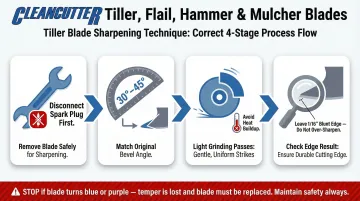
Angle grinder method:
- Use a metal grinding disc or flap disc
- Match the blade's original bevel angle (typically 30–45 degrees)
- Work in smooth, light passes along the cutting edge
- Never press hard or hold the grinder in one spot
Prolonged grinder contact generates heat that strips the blade's temper and softens the metal. Common tiller blade steels get their hardness through specific heat treatment — once grinding friction pushes the steel past its tempering threshold (often 390°F to 750°F), the hardness is gone permanently.
Watch the color: if the blade turns blue or purple during grinding, the temper is lost and the blade needs to be replaced.
For blades that are mildly dull rather than severely worn, a metal bastard file is the better choice — it's slower, but it gives more control and eliminates heat buildup entirely.
Never try to grind out pits, deep nicks, or scored sections. Removing that much metal thins the blade and creates a stress concentration that can cause fracture during use. If the damage requires significant grinding to correct, replace the blade instead.
Critical sharpening guidelines:
- Sharpen only the front cutting edge—never the back side, as this alters clearance angle
- Leave a 1/16" blunt edge rather than a razor edge to prevent chipping on impact with rocks
- Use light, controlled passes to avoid heat buildup
Post-Sharpening Check
After sharpening all blades, compare each blade's weight and edge profile. Uneven blades create vibration imbalance that stresses the tiller's shaft and bearings.
If significant material has been removed from some blades but not others, replace the entire set. Mismatched blades cause excessive vibration that leads to structural housing cracks, elongated bolt holes, and gearbox bearing failure.
When Sharpening Will Actually Ruin Your Blades (And What to Do Instead)
Not all blades can or should be sharpened. Certain physical conditions disqualify a blade from sharpening, and specialized blade types require different maintenance approaches entirely.
Physical Conditions That Disqualify Sharpening
Replace blades immediately if they show any of these conditions:
- Visible cracks or fractures anywhere on the blade body
- Bends or twists in the blade structure
- Heavy rust that has pitted the metal surface
- Deep scoring that would require removing more than a few millimeters of material
In all of these cases, sharpening either won't help or will accelerate failure. A cracked blade will fracture under load. A bent blade creates imbalance and vibration. Heavily rusted metal has lost structural integrity. Deep scoring requires removing so much material that the blade becomes dangerously thin.
The Hard-Faced Blade Exception
Hard-faced blades with carbide or hard-face overlays are specifically engineered to wear in a self-sharpening pattern. Do not sharpen them with standard grinding methods.
These blades self-sharpen through "differential wear": the softer steel substrate wears away faster than the ultra-hard carbide matrix on the leading edge. That continuous shedding naturally keeps the hard carbide edge exposed and sharp. Research shows hard-faced blades exhibit up to 2.5x higher wear resistance compared to standard steel.
Standard grinding destroys this engineered wear pattern. Tungsten carbide is exceptionally hard and brittle, so conventional aluminum oxide wheels generate enough heat to cause micro-fractures and chipping in the carbide overlay. If reconditioning is unavoidable, it requires professional diamond-wheel grinding—a specialized service most operators won't have on-site.
You can identify hard-faced blades by:
- Visible weld beads or distinct overlay layers on the leading edge
- Brazed tungsten carbide inserts along the cutting surface
- "Hard-faced" or "carbide-tipped" markings on the blade or packaging
The Super-Koat Coating Consideration
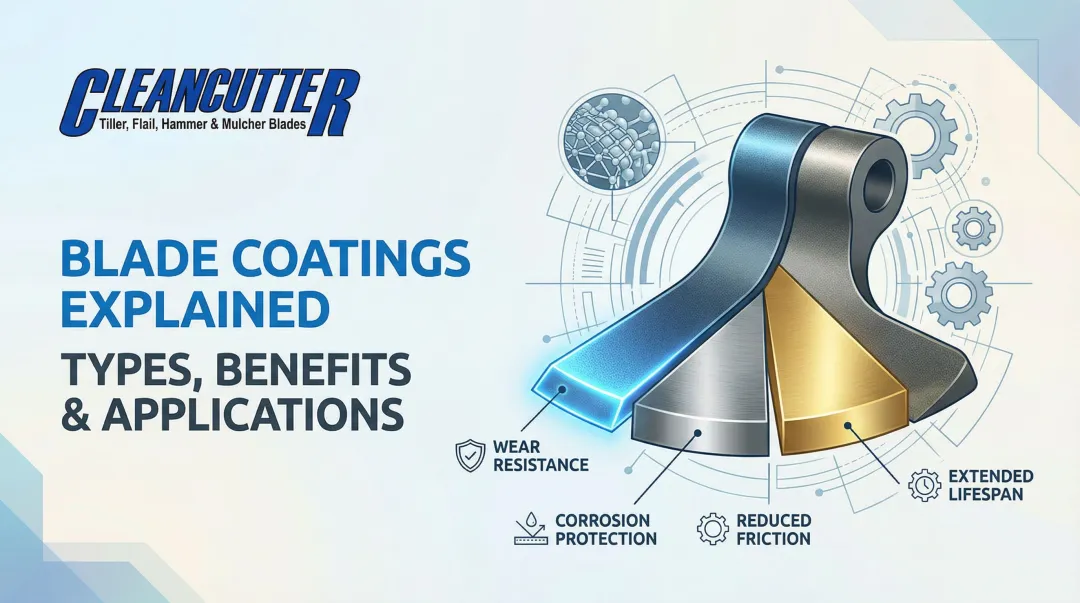
The same logic applies to proprietary surface treatments. Clean Cutter's Super-Koat blades carry a protective coating that enhances durability and wear resistance, and aggressive angle grinder work can strip that coating entirely—leaving bare metal without the protection you paid for.
If a blade has been sharpened more than once and still underperforms—or shows any of the physical damage signs above—replacement is the more practical call. Grinding down a coated or hard-faced blade to bare metal costs you the treatment and doesn't restore the blade to original performance. A fresh replacement in the right grade (standard, hard-faced, or Super-Koat) will outperform a heavily reconditioned blade from the start.
Best Timing for Sharpening: When in the Season and Workflow to Do It
Timing your sharpening work correctly prevents mid-job failures and protects blades during storage.
Pre-Season Inspection as the Primary Checkpoint
Inspect and sharpen (or replace) blades before the first major tilling of the year. This ensures you're not discovering blade problems mid-job when you're on a tight planting schedule. Pre-season inspection is also the right time to check for winter corrosion or damage that occurred during storage.
Post-Job Sharpening Triggers
After tilling rocky, compacted, or debris-heavy ground, inspect blades before the next use. These conditions dull or damage blades faster than normal soil. A blade that looked fine at the start of a job can be significantly dulled or chipped by the end when working in harsh conditions.
The Storage Timing Caution
Do not sharpen immediately before winter storage unless you apply a protective coating. Freshly sharpened blades expose bare metal that's highly vulnerable to flash rust — months of storage without protection can leave significant corrosion by spring.
Two options that work well:
- Sharpen in fall, then immediately coat the fresh edge with oil, grease, or rust-inhibiting primer before storing
- Skip fall sharpening entirely and sharpen in early spring, right before the season starts
Frequently Asked Questions
Are you supposed to sharpen tiller blades?
Sharpening is possible and can extend blade life if done correctly, but many tiller blades—especially hard-faced or coated types—are designed to self-sharpen or are simply replaced when worn. Check your blade type before reaching for the grinder.
What is the maintenance of a tiller?
Core tiller maintenance covers cleaning after each use, changing oil, inspecting and sharpening or replacing tines, clearing air filters, tightening hardware, and proper storage to prevent rust. Re-torque blade bolts after the first 8–10 hours, then every 50 hours.
Why are my tiller blades not turning?
Most likely causes: debris wrapped around the tine shaft, a worn or broken drive belt, a disengaged tine clutch, or a damaged gearbox. Always disconnect power before inspecting, and consult your equipment manual for model-specific steps.
How do you know when tiller blades need sharpening?
Key signals include the tiller bouncing rather than digging, requiring multiple passes for normal depth, the engine straining more than usual, or a visual inspection showing a flat or chipped blade edge instead of a defined bevel.
Can you sharpen hard-faced tiller blades?
Hard-faced blades should generally not be sharpened with standard grinding methods because the carbide overlay is the wear-resistant element. Grinding it away defeats the purpose of the blade design. Replacement is typically the correct action when hard-faced blades wear out.
How often should tiller blades be replaced?
It depends on soil type, usage hours, and blade grade. Standard blades in heavy use may need annual replacement; hard-faced or coated blades last considerably longer. Replace when blades have lost 20–30% of original thickness or show visible damage—condition matters more than the calendar.