Introduction
Run your tiller blades in the wrong direction and you'll know it fast—extra passes, rough seedbed, overworked engine. Rotation direction (forward or reverse) directly controls tillage depth, soil texture, horsepower demand, and blade wear rate.
Matching the right rotation to your soil conditions eliminates wasted fuel, reduces premature blade wear, and gets you a consistent seedbed faster. Here's what each direction does—and when to use it.
Key Takeaways
- Forward rotation produces shallower till with finer, more uniform texture and requires less horsepower
- Reverse rotation delivers deeper, more aggressive soil disruption—ideal for compacted or heavy soils
- Best for small plots, garden beds, and light or already-aerated soils; expect multiple passes for thorough coverage
- Reverse rotation suits large fields, single-pass operations, heavy clay or dry compacted soils, and high-volume crop residue incorporation
- Reverse rotation's aggressive cutting action accelerates blade wear, so durability and blade grade matter more in those applications
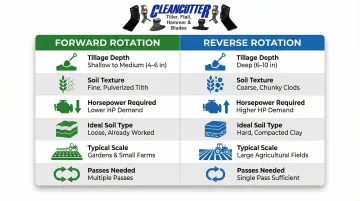
Forward vs. Reverse Tiller Blades: Quick Comparison
| Feature | Forward Rotation | Reverse Rotation |
|---|---|---|
| Tillage Depth | Shallow (2–6.5 inches typical) | Deep (up to 10+ inches) |
| Soil Texture | Fine, uniform, smooth seedbed | Coarser with broken clumps |
| Horsepower Requirement | Lower | Higher |
| Ideal Soil Type | Light, loamy, sandy, pre-tilled | Heavy clay, compacted, virgin sod |
| Typical Scale | Garden, small plot | Large field, commercial |
| Passes Needed | Multiple | Single pass often sufficient |
Both rotation types work with the same basic blade shapes—Both rotation types use the same blade shapes: C-shaped, L-shaped, bolo, and pick tines. What changes is how aggressively each blade edge contacts the soil during rotation, which directly affects wear patterns and blade life.
Neither direction is universally better. The right choice depends on your soil type, tillage depth goals, and operation scale — factors covered in the sections below.
How Forward Tiller Blade Rotation Works
Mechanical Action
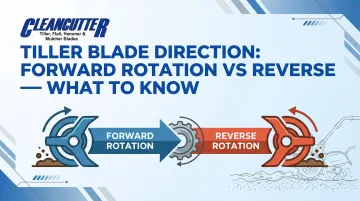
In forward rotation, the tines spin in the same direction as the tractor's forward movement (clockwise when viewed from behind the tiller). The blades scoop soil upward and throw it forward, working the soil through impact and displacement.
Because the tine rotation actively propels the machine forward, operators can't slow the ground speed to force deeper penetration — the implement sets its own pace, which limits how deep the blades work into the soil.
Soil Outcome
Forward rotation produces:
- Shallow till depth: Typically 2–6.5 inches maximum working depth
- Fine, even soil surface: The forward-throwing action pulverizes soil into a smooth, ready-to-plant seedbed
- Uniform texture: Ideal for seed germination and precision planting
The forward momentum of the tines tends to push the tractor forward, which means the implement can "walk" over hard or compacted soil rather than digging into it. That characteristic shapes where forward rotation performs best — and where it falls short.
Best-Fit Conditions
Forward rotation excels in:
- Light to medium-textured soils (sandy loam, silt loam)
- Pre-tilled or already-aerated garden beds
- Fields with minimal crop residue
- Finish tillage where surface texture and evenness are the priority
- Small-scale operations where seedbed precision is the priority
Key Limitations
- Less effective in compacted or clay-heavy soils
- Requires multiple passes to achieve results comparable to a single reverse-rotation pass
- Cannot efficiently bury heavy volumes of crop residue
- Tends to bounce or walk over hard surfaces rather than penetrating them
How Reverse Tiller Blade Rotation Works
Mechanical Action
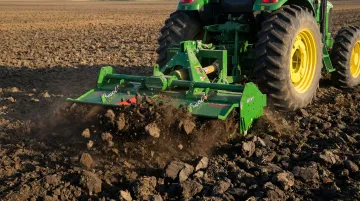
In reverse rotation, the tines spin counter to the direction of travel (counter-clockwise when viewed from behind). The blades dig down into the soil and throw material backward rather than forward, creating a more aggressive cutting and lifting action.
That bottom-up cutting action actively pulls the tiller down into the ground, preventing the implement from walking on top of hard soil. The operator controls forward speed independently of tine motion, allowing for better depth management.
Soil Outcome
Reverse rotation produces:
- Deeper penetration: Up to 10.6 inches working depth in heavy-duty models
- Aggressive soil disruption: Breaks apart compacted layers and hardpan more effectively
- Better residue incorporation: Buries crop residues into deeper layers
- Unique soil layering: Large clods and residue hit the rear deflectors and fall first, while pulverized soil falls last—effectively burying debris at the bottom of the trench
Field tests in Bangkok clay soil demonstrated that reverse-rotary tillers consumed 34% less PTO power than conventional forward tillers during the first pass at 1.0 km/h forward speed. Reverse rotation throws sliced clods backward cleanly, avoiding the energy waste of re-tilling the same soil twice.
Best-Fit Conditions
Reverse rotation excels in:
- Heavy clay or compacted soils that resist standard tine penetration
- Dry or previously untilled ground
- Large-scale field operations where a single pass drives efficiency
- Fields with significant crop residue that must be thoroughly buried
- Virgin sod or land reclamation projects
Torque Protection Systems
Because reverse rotation encounters far greater resistance, these tillers require robust torque protection. The two standard options differ in how they respond to shock loads:
| Feature | Slip Clutch | Shear Pin |
|---|---|---|
| How it works | Friction plates slip to limit torque under shock loads | Sacrificial fastener breaks, disconnecting the PTO drive |
| Best for | Commercial use, varied soils with hidden obstacles | Light duty, predictable soils without heavy rocks |
| Reset method | Automatically resets once obstruction clears | Requires manual bolt replacement after each incident |
| Maintenance note | Seasonal run-in needed to prevent disc oxidation and seizing | Must be torqued to OEM specs — typically 8 ft-lbs |
For commercial operations, slip clutches are the practical choice: they reset automatically and keep downtime low. Shear pins work fine in controlled conditions but halt work every time they blow.
Forward vs. Reverse Rotation: Which Should You Choose?
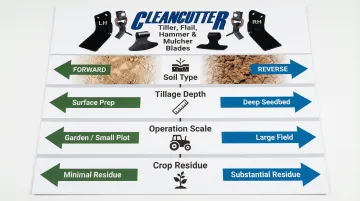
Soil Type Is the Primary Driver
- Light, loamy, or sandy soils: Forward rotation's lower-intensity action is sufficient and produces excellent seedbed texture
- Heavy clay, compacted, or previously untilled soils: Reverse rotation's deeper, more forceful disruption is necessary to break through hard layers
Tillage Depth Goal Matters
- Surface preparation (top 2–4 inches): Forward rotation is sufficient
- Deep seedbed prep, subsoiling, or breaking a hardpan layer: Reverse rotation is necessary
Operation Scale Affects Efficiency
- Gardens, small plots, precision work: Forward rotation tillers are suited for controlled, detail-oriented tillage
- Large-scale field operations: Reverse rotation tillers reduce fuel use and labor time by making a single productive pass instead of multiple runs
Crop Residue Volume Is a Deciding Factor
- Minimal residue: Forward rotation handles incorporation adequately
- Substantial standing or chopped residue: Reverse rotation buries it more thoroughly into the soil, improving decomposition and reducing interference with planting
Blade Durability Becomes Critical in Reverse Rotation
The aggressive counter-rotation places higher mechanical stress on each blade edge, accelerating wear especially in abrasive soils. This is where blade construction quality affects operational cost.
Clean Cutter's Hard-Faced and Super-Koat tiller blades are built for exactly this scenario — both coatings extend blade life in heavy reverse-rotation use, reducing replacement frequency and keeping downtime low across multiple seasons.
Conclusion
The decision between forward and reverse rotation comes down to three practical realities: your soil's texture and compaction level, the depth and quality of seedbed preparation required, and the scale of the operation.
Forward rotation excels in light, controlled settings where fine seedbed texture and precision matter. Reverse rotation is the right tool for aggressive, high-output tillage in compacted soils and large-scale operations.
Regardless of rotation direction, blade condition and construction quality determine how well either setup holds up in the field. Worn blades lose their bite; low-grade steel loses its edge faster than the soil loses its moisture. Choosing the right hardness grade — plain, hard-faced, or a coated option like Super-Koat — is just as important as getting the rotation direction right for your conditions.
Frequently Asked Questions
Should you till forward or backward with a tiller?
Forward tilling works best for light, already-loosened soils and garden-scale work, while backward (reverse) tilling is better suited to hard, compacted soils and larger plots where deeper penetration and single-pass efficiency matter.
What is the difference between forward and reverse tiller blades?
The blades themselves are often the same shape, but the direction they spin changes how they contact soil—forward rotation lifts and throws soil forward for a shallow fine till, while reverse rotation digs and throws soil backward for a deeper, more aggressive break-up.
Which way do tiller tines rotate?
It depends on the tiller type: forward tine tillers rotate in the same direction as tractor travel, while reverse tine tillers rotate opposite to travel. Checking the operator's manual or observing the blade arc confirms the rotation direction on a specific machine.
What are the different types of tiller blades?
Common types include C-shaped or L-shaped tines (universal use), bolo blades (general cultivation), and pick/spike tines (hard, compacted ground). Blades are further differentiated by grade: plain, hard-faced, or coated, each affecting wear life and soil performance differently.
Should tiller blades be sharp?
Tiller blades don't need razor sharpness, but they should be free of excessive wear, curling, or blunting. Industry guidance indicates blades should be replaced when worn past 15–20% of their original size. A blade that has lost its profile will drag rather than cut, raising horsepower demand and reducing till quality.