Introduction
Operators running flail mowers know that cut quality depends less on horsepower than on blade selection. The wrong blade style leaves behind ragged vegetation, uneven mulch distribution, and accelerated wear on rotor hardware — problems that compound quickly across large acreage.
Mulching blades for flail mowers are designed to chop and re-chop material before it exits the deck, returning finer clippings to the soil rather than leaving debris rows behind. But not every blade marketed as a "mulcher" performs equally. Blade geometry, steel grade, and rotor compatibility all determine whether you're getting true mulching action or just slower discharge.
This guide covers what separates effective mulching blades from standard flail blades, how to match blade size to your rotor, and which configurations work best for common agricultural and landscaping conditions.
Key Takeaways
- Mulching blades recirculate clippings under the deck to finely shred them, returning up to 59% of applied nitrogen to the soil
- Blade size depends on deck width and spindle count — verify both before ordering to avoid fitment issues
- Match key specs: blade length, center hole diameter, lift style, and material grade
- Top options include Oregon G5 Gator, Husqvarna OEM, MaxPower Commercial, Rotary Corporation, and 8TEN LawnRAZOR
- Always cross-reference your mower's OEM part number before purchasing
What Makes a Mulching Blade Different on a Zero-Turn Mower
Physical Design: Curved Geometry vs. High-Lift
The core difference between a mulching blade and a standard high-lift blade lies in airflow manipulation. High-lift blades feature an aggressive upward sail at the trailing edge, creating a powerful vacuum that lifts grass for a clean cut and forcefully ejects clippings out the discharge chute or into a bagger.
Mulching blades use a curved or S-shaped cutting edge combined with serrated surfaces. This geometry redirects airflow to keep clippings suspended directly in front of the cutting edge, allowing them to be re-cut multiple times into fine particles before being forced down into the turf canopy.
Why ZTR Blade Dynamics Matter
Zero-turn mowers operate at far higher blade tip speeds than walk-behind mowers to process large volumes of grass quickly. ANSI/OPEI B71.1 safety standards cap maximum tip speed at 19,000 feet per minute (approximately 215.9 mph). Commercial ZTRs like the Exmark Lazer Z operate at approximately 18,500 fpm.
At these speeds, using the wrong blade style creates serious problems:
- Reduced cut quality from improper airflow patterns
- Increased spindle bearing wear due to vibration from unbalanced blades
- Deck clogging when mulching blades lack proper recirculation chambers
Three Main Mulching Blade Types for ZTRs
Matching blade type to your operating conditions matters as much as fit:
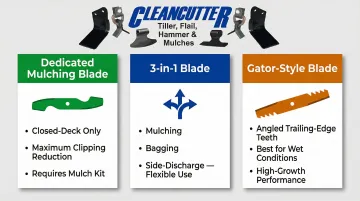
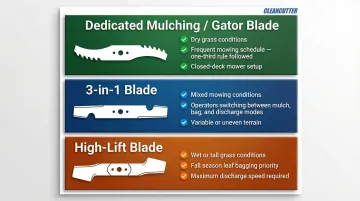
- Dedicated mulching blades — Extended cutting edges and curved profiles work strictly with closed-deck baffle systems. Maximum clipping reduction, but require a mulching kit to function correctly.
- 3-in-1 blades — Handle mulching, bagging, and side-discharge in one blade. Slightly less efficient at pure mulching, but practical for operators who switch modes frequently.
- Gator-style blades — Oregon's patented Gator® Mulcher design uses angled trailing-edge teeth to keep clippings in the cutting path longer. Best choice for high-growth or slightly wet conditions where standard mulching blades bog down.
The Critical Role of Deck Baffles
Mulching blades cannot function effectively in isolation — they require a closed deck environment created by baffles and block-off plates (mulch plugs). These components seal the discharge chute and create isolated cutting chambers that force clippings to circulate repeatedly through the blades.
Running mulching blades on an open-discharge deck without baffles breaks the recirculation vortex entirely. The result: poor cut quality and visible grass clumps left across the lawn.
Zero-Turn Mower Mulching Blade Size Guide
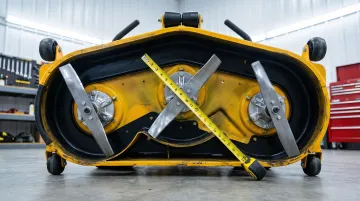
Blade Length Correlates to Deck Width and Spindle Count
The most common mistake: Assuming all blades for a given deck size are interchangeable. Blade lengths vary drastically depending on whether the manufacturer uses a two-blade or three-blade spindle configuration.
Common blade length-to-deck size pairings:
| Deck Width | Example ZTR Model | Spindle Count | Individual Blade Length |
|---|---|---|---|
| 42" | Toro TimeCutter MX 4260 | 2 Blades | 21.6" |
| 42" | Scag SZL-42H | 3 Blades | 14.75" |
| 48" | Exmark Lazer Z / Pioneer | 3 Blades | 16.25" |
| 54" | Husqvarna MZ54 | 3 Blades | 18.5" |
| 60" | Exmark Lazer Z X-Series | 3 Blades | 20.5" |
| 72" | Exmark Lazer Z Diesel | 3 Blades | 24.5" |
Critical Sizing Specs Beyond Blade Length
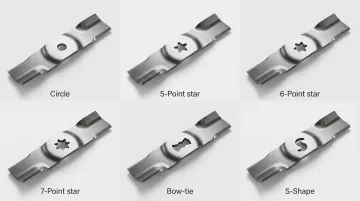
Center Hole Diameter: Blade mounting interfaces are not standardized across the OPE industry. Installing a blade with the incorrect center hole can strip the spindle shaft or cause the blade to detach at high operating speeds — a serious safety hazard.
Common center hole geometries:
- 5/8" Round: Toro, Bad Boy, Scag commercial ZTRs
- 15/16" Round: Exmark heavy-duty commercial applications
- 5-Point Star: Husqvarna and AYP/Poulan ZTRs
- 6-Point Star & Bow-Tie: MTD, Cub Cadet, Troy-Bilt
Blade Thickness: Commercial-grade ZTR blades range from 0.197" to 0.250" thick. Thicker blades withstand impacts better and maintain edge retention longer.
Blade Balance: Operating at 19,000 fpm, blades must be balanced to within 1.5 oz-in. Even a fraction of an ounce of imbalance creates severe vibration, causing accelerated wear on sealed ball bearings inside the spindle housing.
How to Find the Correct Size for Your Mower
The safest method: Locate the OEM part number stamped directly into the metal of your existing blade or in the owner's manual. Use this number with an aftermarket cross-reference catalog to find compatible mulching blade replacements.
Never:
- Buy based on deck size alone
- Assume universal blades fit without checking center hole and mounting pattern
- Ignore blade balance specifications
Blade Weight Tradeoff
Blade thickness also determines how much punishment a blade can take — and how much punishment it inflicts on your spindle bearings.
Heavier blades (0.225"–0.250" thick) retain more momentum and cut through thick or overgrown grass more effectively. The tradeoff is increased spindle load, which accelerates bearing wear over time. Lighter blades (0.187"–0.203" thick) reduce that load, making them a better fit for residential use where grass conditions are more consistent.
- Residential ZTR owners: Choose lighter blades to extend spindle life
- Commercial operators on dense or irregular growth: Heavier blades justify the added bearing wear through better cut quality and fewer slowdowns
Best Mulching Blades for Zero-Turn Mowers
The options below were selected based on compatibility breadth, material quality, mulching performance, and availability across common zero-turn mower brands. Each entry includes size coverage, compatibility, and the conditions where it performs best.
Oregon G5 Gator Mulching Blades
Oregon Tool is a premier OPE aftermarket manufacturer. Their Gator® Mulcher family includes the G3, G5, and G6 lines. The G5 features "Fusion" technology—a process that infuses tungsten carbide into the cutting edge to double the time between sharpenings.
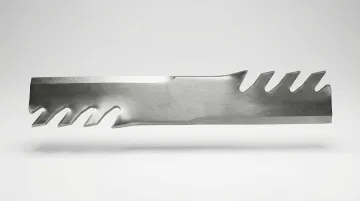
The serrated Gator teeth along the trailing edge aggressively re-cut clippings, making the G5 effective for ZTRs used in high-growth or slightly wet conditions where standard mulching blades struggle.
| Specification | Details |
|---|---|
| Blade Lengths Available | 16-11/16", 18.5", 20.5", 21", 22-7/8" (covers 42"–72" decks) |
| Compatibility | Husqvarna, Ariens, Gravely, Toro, Exmark, Scag (verify specific model cross-references) |
| Best For | High-growth grass, coarser conditions, commercial ZTR operators needing aggressive re-cutting |
Husqvarna OEM Mulching Blades
Husqvarna's OEM mulching blades are manufactured to factory specifications for exact balance and fit, reducing the risk of vibration at high spindle speeds. The company offers dedicated mulch blades for 48" decks (OEM #588811302) and high-lift/mulch blades for 54" decks (OEM #582062502).
For complete mulching systems, Husqvarna sells comprehensive kits (such as OEM #598390501 for 54" Z400/Z500 series) that include both deck-specific baffles and blades.
| Specification | Details |
|---|---|
| Blade Lengths Available | 18.5" (48" decks), 18.5" (54" decks), multiple sizes for 42"–72" decks |
| Compatibility | Husqvarna zero-turn mowers (residential MZ series through commercial Z500 series) |
| Best For | Husqvarna ZTR owners who prioritize guaranteed OEM fit and factory-matched cut performance |
MaxPower Commercial Mulching Blades
If retail availability matters, MaxPower is worth a look. This U.S.-based aftermarket manufacturer supplies blades through Home Depot, Lowe's, and Amazon. Their "Commercial" tier of 3-in-1 mulching blades features sharpened cutting teeth and greater cutting surface area.
MaxPower commercial mulching blades are made from hardened steel and offer an accessible price point with solid compatibility coverage across both residential and commercial ZTR brands.
| Specification | Details |
|---|---|
| Blade Lengths Available | 16"–22" range covering 42"–60" decks |
| Compatibility | MTD family (Cub Cadet, Troy-Bilt), Toro, Exmark, Husqvarna, Craftsman |
| Best For | Budget-conscious buyers, multi-brand fleets, operators needing easy retail availability |
Rotary Corporation Mulching Blades
Rotary Corporation is the world's largest supplier of aftermarket OPE parts, operating primarily as a dealer-facing distributor. Their premium "Copperhead" commercial mulching blade line is trusted by equipment dealers and commercial landscaping operations for reliable blade-for-blade OEM replacement.
Rotary's master catalog provides exact OEM cross-references — for example, Rotary Part #11244 (24.5" mulcher) replaces Exmark OEM #103-6394.
| Specification | Details |
|---|---|
| Blade Lengths Available | 14.75"–24.5" covering 42"–72" decks |
| Compatibility | Exmark, Toro, Ferris, Scag, Bad Boy via Rotary's cross-reference system |
| Best For | Commercial landscapers and equipment shops needing reliable dealer-sourced mulching blade replacements |
8TEN LawnRAZOR Mulching Blades
8TEN Parts produces the LawnRAZOR line, widely available on Amazon in multi-packs that make stocking up straightforward. The LawnRAZOR offers reasonable mulching performance with solid steel construction and a straightforward cross-reference system.
For example, their 50" Cub Cadet set (Part #810-CBL2426D) replaces OEM #942-05067 (6-point star), and their 42" Husqvarna set (Part #810-CBL2224D) replaces OEM #532138971 (5-point star).
| Specification | Details |
|---|---|
| Blade Lengths Available | 16"–22" covering 42"–54" decks |
| Compatibility | MTD, Cub Cadet, Husqvarna, Ariens, Craftsman, Poulan (cross-reference OEM part numbers) |
| Best For | Homeowners with residential or prosumer ZTR mowers shopping online for cost-effective mulching blade sets |
How to Choose the Right Mulching Blade for Your Zero-Turn
Start with OEM Part Number Matching
The safest way to find a compatible mulching blade is to pull the original blade's stamped part number and use a cross-reference catalog. This ensures the center hole diameter, mounting pattern, and blade dimensions all match the spindle and deck design.
Buying by deck size alone is a common and costly mistake. A 42" deck might require two 21.6" blades or three 14.75" blades depending on the manufacturer's spindle configuration.
Evaluate Blade Material and Hardness
Standard carbon steel blades are affordable but require frequent sharpening, especially in sandy or abrasive soil conditions.
Hardened or coated blades resist edge wear longer. Hard-faced blades, for example, maintain sharp edges longer in abrasive conditions — reducing sharpening frequency and total replacement costs over a season.
Match Blade Type to Mowing Conditions
Material and hardness get you to the right blade construction. Blade type determines how well it performs under your specific mowing conditions.
Dedicated mulching blades or Gator-style blades work best when:
- Grass is dry
- Mowing height follows the "One-Third Rule" (never remove more than one-third of the leaf blade in a single cut)
- Grass is cut frequently
3-in-1 blades offer flexibility for:
- Operators who switch between mulching, bagging, and side-discharge
- Variable mowing conditions
High-lift blades are preferable when:
- Grass is wet or excessively tall
- Bagging heavy fall leaves
- Discharge speed is more important than nutrient recycling
Conclusion
Choosing the right mulching blade for a zero-turn mower comes down to three things: correct sizing for your specific deck and spindle, the right blade style for your lawn conditions, and material quality that holds up to your mowing frequency and terrain.
Before purchasing, verify OEM specs by checking the stamped part number on your existing blade or consulting your owner's manual. Upgrade to a hardened or coated blade for longer service intervals, and re-evaluate blade choice seasonally if mowing conditions change significantly.
When in doubt, start with an OEM-equivalent blade at the correct length and thickness, then adjust based on cut quality and wear patterns over a few mowing seasons. The right blade won't just improve your finish—it'll reduce strain on your deck spindles and engine over the long run.
Frequently Asked Questions
Should I use mulching blades on my zero-turn mower?
Yes, mulching blades are beneficial for most ZTR users, and research shows they return 46% to 59% of applied nitrogen back to the soil, reducing fertilizer costs. However, they work best when paired with a mulching kit and used in dry conditions on grass that hasn't grown too tall between cuts.
Do mulching blades make a difference on zero-turn mowers?
Mulching blades make a measurable difference: the re-cutting design reduces visible clumps, improves clipping dispersal, and feeds the lawn with fine organic material. Results depend on grass type, mowing frequency, and whether a deck baffle/mulching kit is installed.
Mulching blades vs high-lift blades: which is better for a zero turn mower?
High-lift blades create more airflow for cleaner discharge and better bagging, making them preferred for tall or wet grass. Mulching blades recirculate clippings for lawn nutrition but can leave clumps if grass is overgrown. The right choice depends on your mowing habits and conditions.
How do I know what size mulching blade to buy for my zero-turn mower?
Check the stamped OEM part number on your existing blade or consult the mower's owner's manual, then use an aftermarket cross-reference to find a compatible mulching blade. Always verify center hole diameter and mounting hole pattern, not just blade length.
What are the best mower blades for a zero turn mower?
The best blade type depends on your use case: mulching blades for nutrient recycling on well-maintained lawns, high-lift for bagging or heavy growth, and Gator/3-in-1 blades for versatility. Always cross-reference your mower's OEM part number to confirm blade compatibility before purchasing an aftermarket replacement.